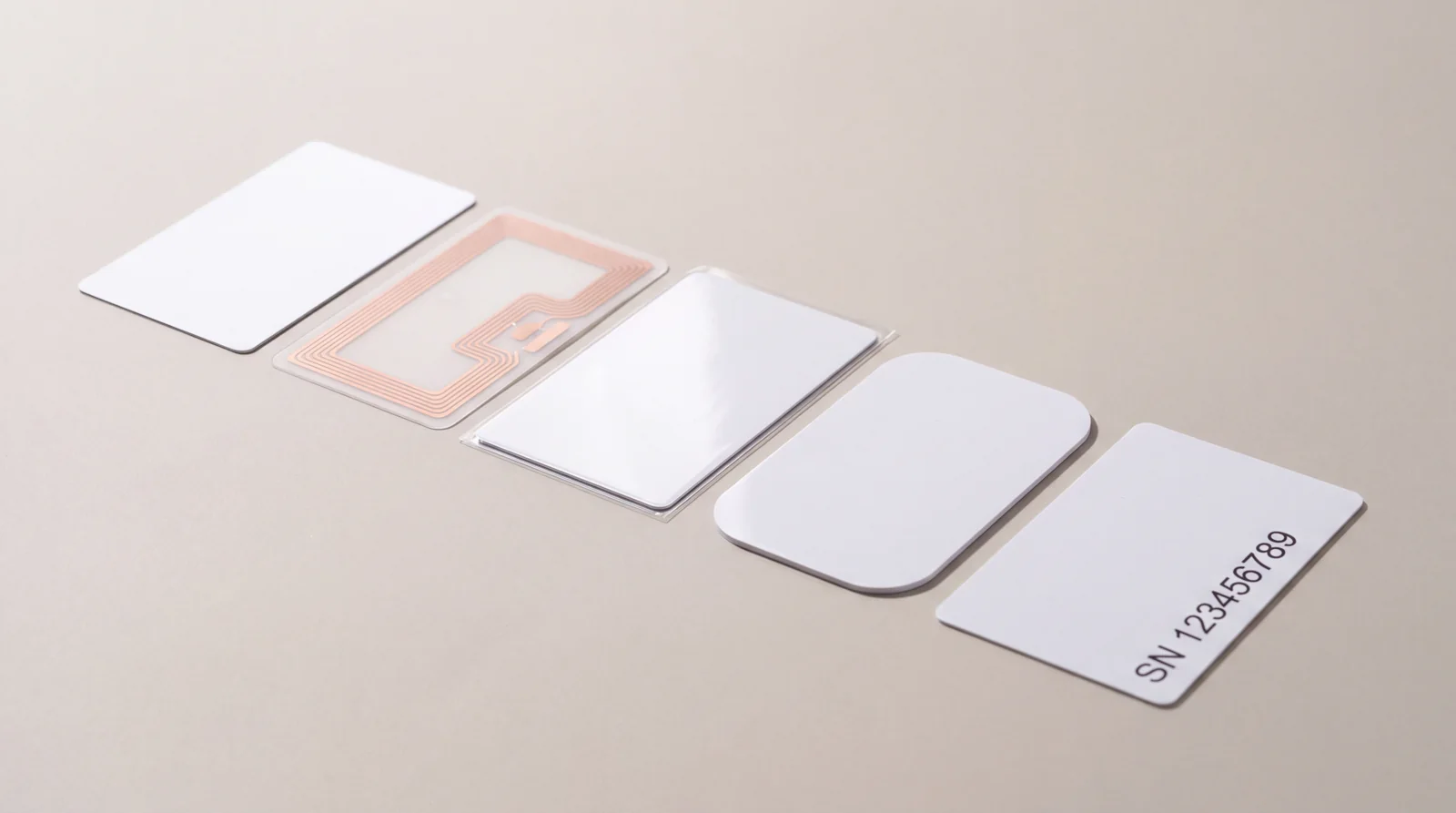
Cards and key fobs
Cards by use
Badges and lanyards
Labels and tickets
Wristbands
Hospitality
Retail and loyalty
Access control
Clubs and associations
Events and festivals
Technical guides on chips, lock compatibility, materials and ordering, written by the people who make the cards.
Why the key card is the part of a sustainability programme a guest actually touches, what a wood card can claim, and what to confirm before ordering.
A production-ready artwork package makes the intended result clear without forcing the printer to guess which file or layer is authoritative.
What counts as variable data, how to specify a numbering range that survives a reorder, and the three ways the printed number can relate to the chip.
Samples answer different questions. Requesting the right type prevents a visual reference from being mistaken for a production qualification.
Why the second order is the risky one, the eight things a specification record has to freeze, and the three variables that drift by themselves.
Two unit prices are comparable only when they describe the same deliverable and commercial scope. Normalise technical scope, charges and exclusions first.
Why wearing time decides the material before anything else, how the six band materials compare on reuse, water and print, and what the closure enforces.
Seasonal ordering needs supplier-specific milestones. A public holiday date does not tell a buyer when a production line or route will stop or restart.
The three routes from blank plastic to a working credential, what a factory legitimately needs in order to encode, and what nobody should ask for.
Qualification is the record of which entity was approved, for which construction, on what evidence, and what the approval does not cover.
How magnetic stripe became RFID, what separates PVC, recycled PVC and wooden card bodies, and how to match a card to the lock system a property already runs.
A quality plan turns the card specification into checks: a test method, an acceptance rule, a sample plan and a named release authority on every line.
When a fob is the right credential instead of a card, what the twelve outlines and the four diameters change, and how a moulded body is decorated.
A reader datasheet narrows the credential options, but supported radio technology is not the same as a working application.
Twelve questions to put to any card factory before you release a purchase order, with why each one matters and what a weak answer tells you.
Custom means something different at every supplier. The ten layers of a card that can be personalised, what each costs in time and what you have to send.
The risk every distributor carries and rarely writes down: introducing a customer to the factory and watching the factory sell to them directly.
Minimum order quantity, lead times in calendar days, the five artwork mistakes that cause reprints, sampling rules and the HS heading a card clears under.
What the five layers of a card actually are, why 0.76 mm is the number every encoder is built around, and the four ways a card fails in the field.
How to compare one hotel key card supplier against another so that an incompatible batch is caught before production, not after freight.
What a CR80 specification must add to the nominal size: acceptance limits, corner and slot geometry, keep-outs and a feed trial on finished cards.
The six stages of plastic and RFID card production, what the buyer controls at each one, and which late changes send a job furthest back.
Production is rarely the long pole. Approvals, chip supply and the shipping decision are. How to plan an order backwards from the date you need it.
A card batch is easiest to reject in the first hour and hardest once it reaches the front desk. What to check, how many, and what to do next.
The chip is only half the credential. Antenna size, inlay placement and what sits around the card decide whether a reader sees it at all.
Offset, digital and screen printing behave differently on plastic, and the finish decides how a card ages in a pocket. How to choose both properly.
Coercivity, tracks and stripe placement decide whether a magnetic key card works. What each one means, and the four causes of a card that fails.
Why the lock brand never specifies the card, the four variables that decide whether a credential authenticates, and what to establish before ordering.
Why key cards that worked start failing after a Visionline AES upgrade, the three variables that decide compatibility, and the checklist that prevents it.
What separates MIFARE Classic EV1, Ultralight EV1 and DESFire EV2 and EV3, where the cheaper chip is still adequate, and what to specify when it matters.
Where the recycled content sits in a card, what an eighty per cent recycled core lets you claim in a tender, what it does not, and what it costs.
What a dual frequency card physically is, why the two inlays do not interfere, the four pairings that cover almost every request, and how to test one properly.
The three tiers of verification, what UV printing, microtext, holograms and hot foil each resist, and why a feature nobody checks is not security.
The six places a manufacturer name reaches your client, the five clauses worth having in writing, and why non circumvention is the real test.
Ask for a free sample in your material and chip.