RFID key fobs in moulded ABS: shapes, sizes and what decides the choice
When a fob is the right credential instead of a card, what the twelve outlines and the four diameters change, and how a moulded body is decorated.
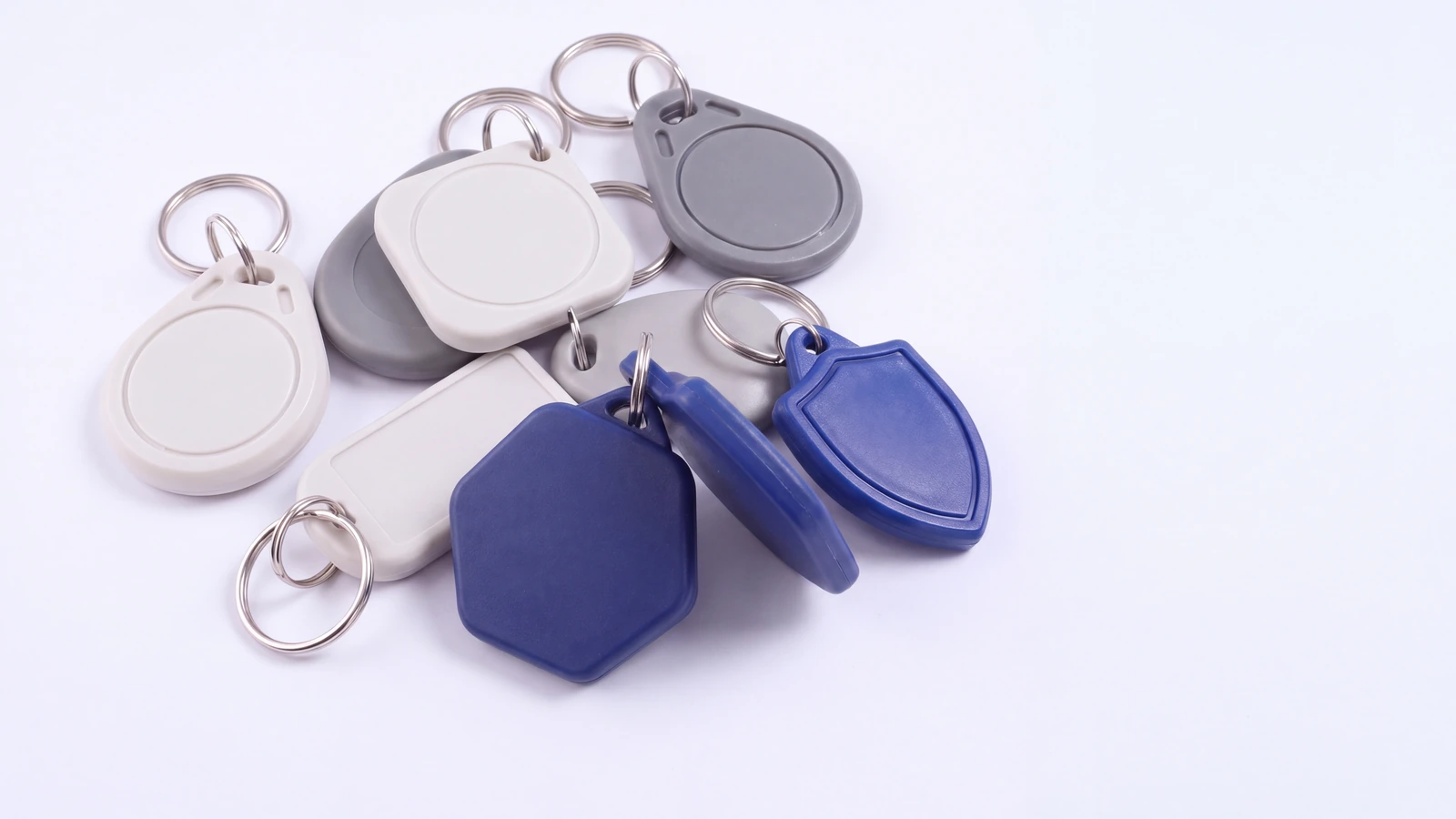
A fob is a card that gave up its printed area in exchange for surviving a keyring. That is the whole trade, and most fob specifications go wrong because one half of it was not considered.
The half that gets forgotten is usually the printed area. A fob is specified because staff keep breaking cards, the order is placed, and only when the artwork arrives does anybody notice that the logo, the property name, the department and a serial number were all meant to fit on a curved surface the size of a coin. The other half gets forgotten in the opposite direction: a beautiful card is specified for people who will drop it on a concrete floor twice a day.
This guide covers when a fob is the right object, what the shape and the diameter actually change, and what a moulded body can and cannot carry. It is written for whoever is specifying: a distributor, an integrator, or a facilities team issuing credentials to staff.
01. Card or fob
The chip does not care which body it sits in. The person carrying it does, and so does whoever has to reissue it.
The arithmetic is worth doing once rather than arguing about. A card that a housekeeper carries on a belt gets replaced perhaps three times a year. A fob on the same belt lasts the length of the employment. Multiply by the number of staff and by the administrative cost of each reissue, which is usually larger than the credential itself, and the higher unit price of a fob disappears inside the first year.
02. What an ABS fob actually is
A moulded body in acrylonitrile butadiene styrene, with an inlay placed inside before the two halves are joined. That construction matters because it is fundamentally different from a laminated card. There are no layers to separate, so the classic card failure of edge delamination simply does not exist on a fob.
What it gives up is the print. A laminated card carries an offset printed image across two large flat faces. A moulded fob carries colour in the material itself, plus engraving or a pad printed mark on a small curved area.
ABS is chosen over other plastics for a specific reason: it is rigid enough to protect the inlay, tough enough to take repeated impacts without shattering, and it takes moulded colour cleanly. It is also opaque, which is why any full colour artwork on a fob has to arrive as a separate printed insert rather than being printed on the body.
03. Twelve outlines, and the hole is part of them
Shapes come from tooling. Twelve outlines cover almost every request, and each one has its ring hole in a specific place, because the hole is cut by the same die that cuts the body.
The shape is a colour code
Where several groups share one estate, a different outline per group lets a supervisor see at a glance whether somebody is carrying the right credential. That is worth more operationally than a printed label a keyring will scuff off.
The ring hole deserves a second look before the order is confirmed. It sits where the tooling puts it, and on a few outlines that is close to one edge, which is exactly where a fob that spends five years being pulled against a reader eventually wears through. If the credential is presented many times a day, a hole with more material around it is worth choosing over a shape that looks better in the catalogue.
04. Size is a specification, not a preference
On a card, the antenna fills a fixed footprint and the size question never arises. On a fob it does, because the body decides how much antenna there is.
If a reader is behind a glass panel, recessed into a door, or mounted on metal, the extra antenna area of a 48 or 56 mm body is often the difference between a confident read and an intermittent one. That is worth testing rather than assuming.
Testing here means one thing specifically: take a sample of the size you intend to order to the actual door, with the fob on a keyring carrying the keys people actually carry. A fob tested alone on a desk behaves differently from the same fob pressed against a bunch of metal keys, and the second is the condition it will live in.
05. Frequencies and chips
Fobs take the same chips as cards, at 125 kHz and at 13.56 MHz. In practice EM4200, TK4100 and HITAG 1 cover the low frequency side and MIFARE Classic, Plus and DESFire cover the high frequency side. HITAG 1 in particular turns up more often in fobs than in cards, because a great deal of the installed base it serves is in access control and vehicle systems.
The choice is made the same way as for a card, and the guide to choosing the chip applies unchanged. A dual frequency fob is also possible for an estate running two generations of reader, which is covered in the dual frequency guide, and a fob is a better body for it than a card, because there is more room to keep the two antennas apart.
06. Decoration, and what the curve costs you
Body colour
Moulded through the material, so it does not wear off. This is the most durable decoration a fob has and it is effectively free, which makes it the right way to code groups.
Laser engraving
Permanent, tactile, and it survives everything the fob survives. Single colour by nature. It is the right choice for a sequential number, because the number has to stay readable for the life of the credential and a printed one will not.
Pad printing
A small mark, one or two colours, applied to the flat area. It handles a logo well and photography badly, and on a curved body the printable area is smaller than the outline suggests. A simple mark reproduces cleanly; fine detail and small type do not.
A printed insert
Some shapes take a printed disc under a clear window. This is how a fob carries full colour artwork, and it is worth asking about where branding matters more than the last few years of durability.
07. Attachment
Most fobs ship with a split ring. Two other options are worth knowing about: a short silicone strap, which stops the fob rattling against keys and scratching, and a carabiner or retractable reel for staff who present the credential dozens of times a day. The attachment is a small line on the order and a large part of whether people keep the thing on them.
A credential that is annoying to carry ends up on a desk, in a drawer or lent to a colleague, and every one of those outcomes is a security problem rather than a comfort problem. It is worth asking the people who will carry it what they already carry, and matching the attachment to that.
08. What to specify
- Shape, from the standard set, or a drawing if it has to be new.
- Size, and whether the reader is recessed or on metal.
- The chip, or the reader model it has to work with.
- Body colour, and whether colour codes a group.
- Decoration: engraving, pad print, insert, or none.
- Attachment: ring, strap, carabiner, or supplied loose.
Six lines, and they can be written in an email. The two that most often get left out are the second and the last, and they are the two that decide whether the credential works at the door and stays on the person.
09. Where Kaway fits
We manufacture for the trade and do not sell to your customers. Moulded ABS fobs from 31 to 56 mm across twelve shapes are produced, engraved and encoded on our own floor, in 125 kHz and 13.56 MHz, alongside the cards and wristbands that usually share the same credential.
There is no Kaway marking on the body or in the tooling, which on a moulded product is a question worth asking any supplier, because a cavity mark is part of the die rather than something added afterwards. Minimum order is 500 units, standard production thirteen calendar days from artwork approval to dispatch, and quotes come back the same working day. What a factory needs in order to quote is in the guide to specifying an order.
10. Frequently asked questions
Can a fob and a card carry the same credential?
Yes. Same chip, same configuration, same keys. The system cannot tell them apart, which is exactly the point when staff carry a fob and guests carry a card.
Does a fob read further than a card?
It depends on the size. A 56 mm fob usually reads further than a card. A 31 mm fob usually reads less far. The chip is not what changes.
Can we have our own shape?
Yes, with new tooling. It is a one off cost and it adds time to the first run, so it makes sense on a long programme and rarely on a single order.
Do fobs delaminate like cards?
No. A moulded body has no layers to separate. The failure mode on a fob is a cracked body or a worn ring hole, and both take years.
Can a fob carry full colour artwork?
Only through a printed insert under a window. Direct decoration is body colour, engraving or pad printing, and each is a single or two colour process.
Can fobs be numbered in sequence?
Yes, by laser engraving, which is the durable way to do it. The variable data guide covers how a numbering file has to be supplied and how the printed number relates to the chip UID.
Are fobs waterproof?
A moulded body with the inlay sealed inside handles rain, washing and sweat without difficulty. It is not rated for immersion at depth, and nothing in a normal access control programme asks it to be.
Can fobs be encoded at the factory?
The same rules apply as for cards: it depends on whether the access platform will release the keys or the number range. The encoding guide sets out which of the three routes fits.
Send the reader or lock model, the quantity and the date you need them. That is enough for us to answer.
Talk to us