Hotel key cards: materials, technology and how to choose
How magnetic stripe became RFID, what separates PVC, recycled PVC and wooden card bodies, and how to match a card to the lock system a property already runs.
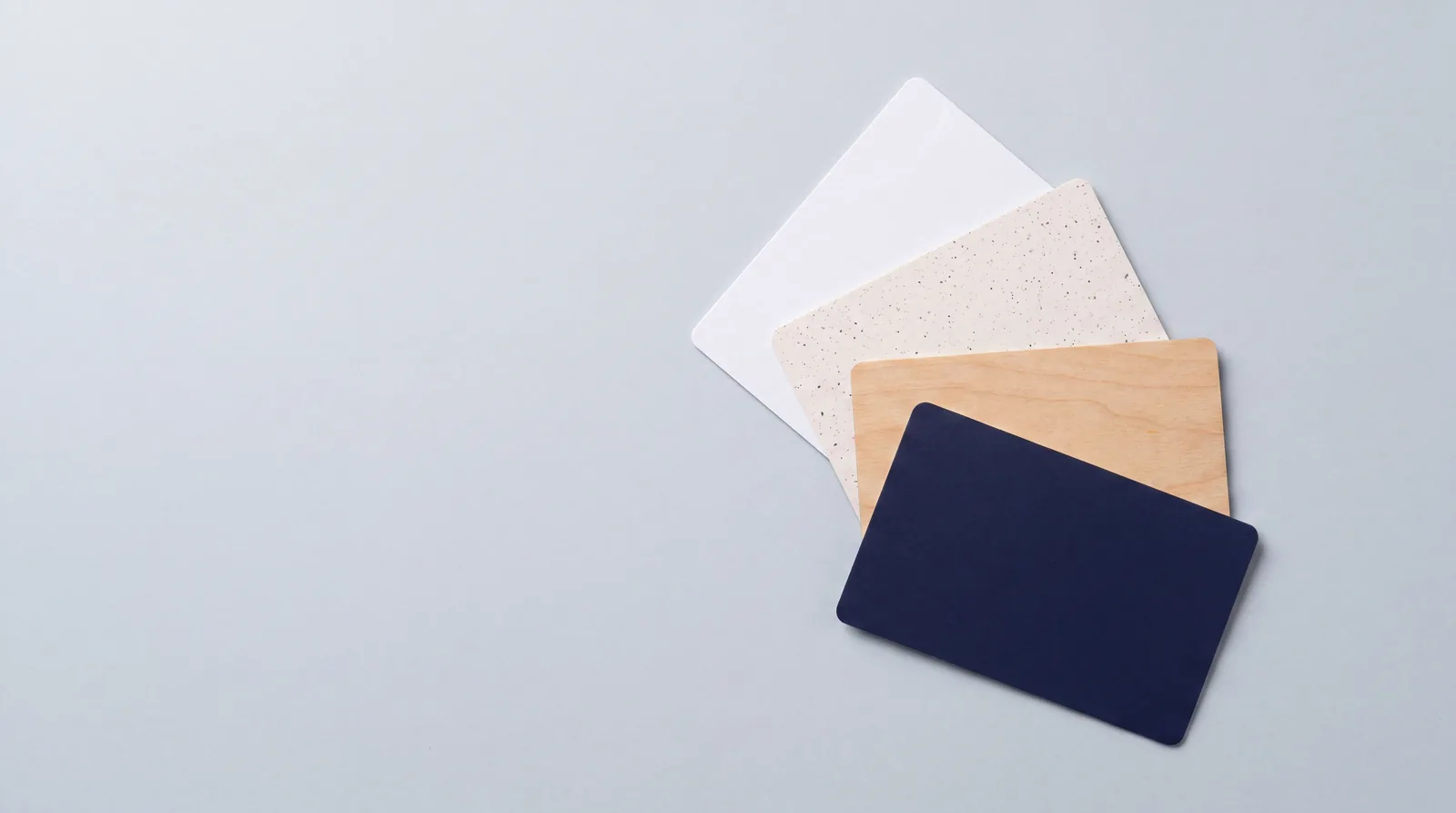
A key card is the first physical object a guest holds at check in. It also has to work on every door, on every floor, for the whole length of a stay. Those two jobs pull in different directions, and most ordering mistakes come from deciding one without checking the other.
This guide covers the three things that decide which card a property should order: the material, the chip and its compatibility with the lock system, and the finish.
01. How hotel key cards got here
Key cards have been through three phases, each shaped by what properties needed at the time.
1. Magnetic stripe
Introduced in the 1970s, the magstripe replaced metal keys and let the front desk reprogram access without changing hardware. It dominated for decades and is still in service in many properties.
2. RFID
The guest holds the card near the reader instead of swiping it. RFID cards are more durable, cannot be demagnetised, and support zone access, time windows and audit trails.
3. Material choice
The technology inside is now settled. What changed is what the card is made of. Wood and recycled plastics are both in normal production, and property groups increasingly choose the body material against their environmental commitments rather than only against cost.
The card is a brand object before it is a tool
Material, weight and finish say something at check in before anyone reads the print on it. That is why the material decision is worth as much attention as the chip.
02. The card body: PVC, recycled PVC and wood
The material decides the cost, the environmental profile and what can be done to the surface. It does not decide whether the card works, which is the chip's job.
PVC
The industry standard, from 0.40 to 1.0 mm. Offset and silkscreen printed, laminated, gloss or matt. Takes a magnetic stripe, a contact chip, a signature panel and security features.
Recycled PVC
The same dimensions and the same production route as standard PVC, so nothing changes in issuance or encoding. It is the step that adds an environmental credential without changing a single operational habit.
Wood and bamboo
Basswood, cherry, black walnut and bamboo, at 1.20 to 1.30 mm. Laser engraved, offset printed and encoded. FSC certified wooden card options are available under licence FSC-C195226, and that certification covers wood and bamboo cards only, not the rest of the range.
What each body can carry
The three bodies do the same things. They are all CR80, they all take RFID and NFC, they all take a magnetic stripe and full colour print. Laser engraving and FSC certification are the only two that separate them, and both belong to wood and bamboo.
Minimum order is 500 units. If you are not sure how that applies to what you need, ask before you specify.
03. Chips, frequencies and lock compatibility
The wrong chip or the wrong frequency produces cards that do not open doors. It is the single most expensive ordering mistake, and it is entirely preventable.
125 kHz, low frequency
Older technology, still widely installed. Chips include EM4200 and T5577. Common in legacy systems.
13.56 MHz, high frequency
The current standard, and what NFC means in practice. Chips include MIFARE Classic, DESFire EV1, EV2 and EV3, NTAG and ICODE. Supports encryption and stronger authentication.
UHF, 860 to 960 MHz
Longer read range. Used where a credential has to be read at distance rather than on contact.
Systems our cards are compatible with
Assa Abloy VingCard, including Visionline and Saflok. Dormakaba. Onity. Salto. Häfele Dialock.
Confirm compatibility in writing before production, not after delivery
Send the lock or reader model you already run. We confirm the chip against it in writing before anything goes into production. A general claim that a supplier works with a lock brand is not the same as a confirmation that names your model.
Can one card carry both a magnetic stripe and a chip
Yes. Combination cards are common in properties moving between systems, where some doors still read the stripe and others read the chip. They are available across the card bodies above.
04. Print, engraving and finishes
Every card is produced to order, so the branding and the specification are built in from the start rather than applied to stock.
1. Full colour print, both sides
Offset and silkscreen on PVC, recycled PVC and wood. Pantone matching, gradients and photography, laminated against wear.
2. Laser engraving
On wood and bamboo. A permanent, tactile finish that can be combined with print on the same card.
3. Surface finishes
Gloss, matt and soft touch on PVC and recycled PVC. Natural grain on wood, which varies between species and is part of the point.
4. Security and detail features
UV printing, microtext, guilloche, hologram and hot stamping. Spot UV puts a gloss highlight on specific areas of a matt card, and embossing raises a texture.
5. Personalisation and encoding
Variable data, photo ID, sequential numbering, barcodes and QR, chip encoding with a UID list, magnetic stripe encoding, signature and scratch panels.
05. Matching the card to the property
There is no single right answer. The card follows the property tier, the lock system, the environmental commitments and the volume.
Five star and boutique
Wood or bamboo. The material is felt at check in, the grain makes each card slightly different, and the FSC option gives the sustainability claim something to stand on.
Four star and full service
Wood or recycled PVC. Wood if the environmental commitment is public and needs a visible object behind it. Recycled PVC if the priority is a credible step that changes nothing operationally.
Three star and branded chains
PVC or recycled PVC. Standard PVC at volume, or recycled PVC for the same operational behaviour with a better environmental profile.
High volume and extended stay
PVC. Durability per unit matters most where cards stay in circulation longer and get reissued often.
06. What to ask before you order
Four questions that separate a supplier who has thought about your property from one who has not.
1. Will you confirm compatibility in writing, naming my lock model?
Ask for confirmation that names the brand and the model number you run, issued before production rather than after delivery. A general statement about a lock brand is not an answer.
2. How do you keep the chip and the configuration consistent between batches?
Repeatability is what stops a second order behaving differently from the first. Ask what the change control procedure is, and who controls chip sourcing and encoding.
3. Can I test a sample against my own doors first?
A sample encoded for your actual system, tested on real doors across more than one zone, catches problems that an encoding station never will.
4. What exactly does the FSC certificate cover?
FSC scope is specific. Ours is licence FSC-C195226, and it covers wood and bamboo cards. Any certificate number can be checked at search.fsc.org, and it is worth checking what the scope actually says rather than accepting the logo.
Send the reader or lock model, the quantity and the date you need them. That is enough for us to answer.
Talk to us