What custom actually covers on an RFID card
Custom means something different at every supplier. The ten layers of a card that can be personalised, what each one costs you in time and what you have to send.
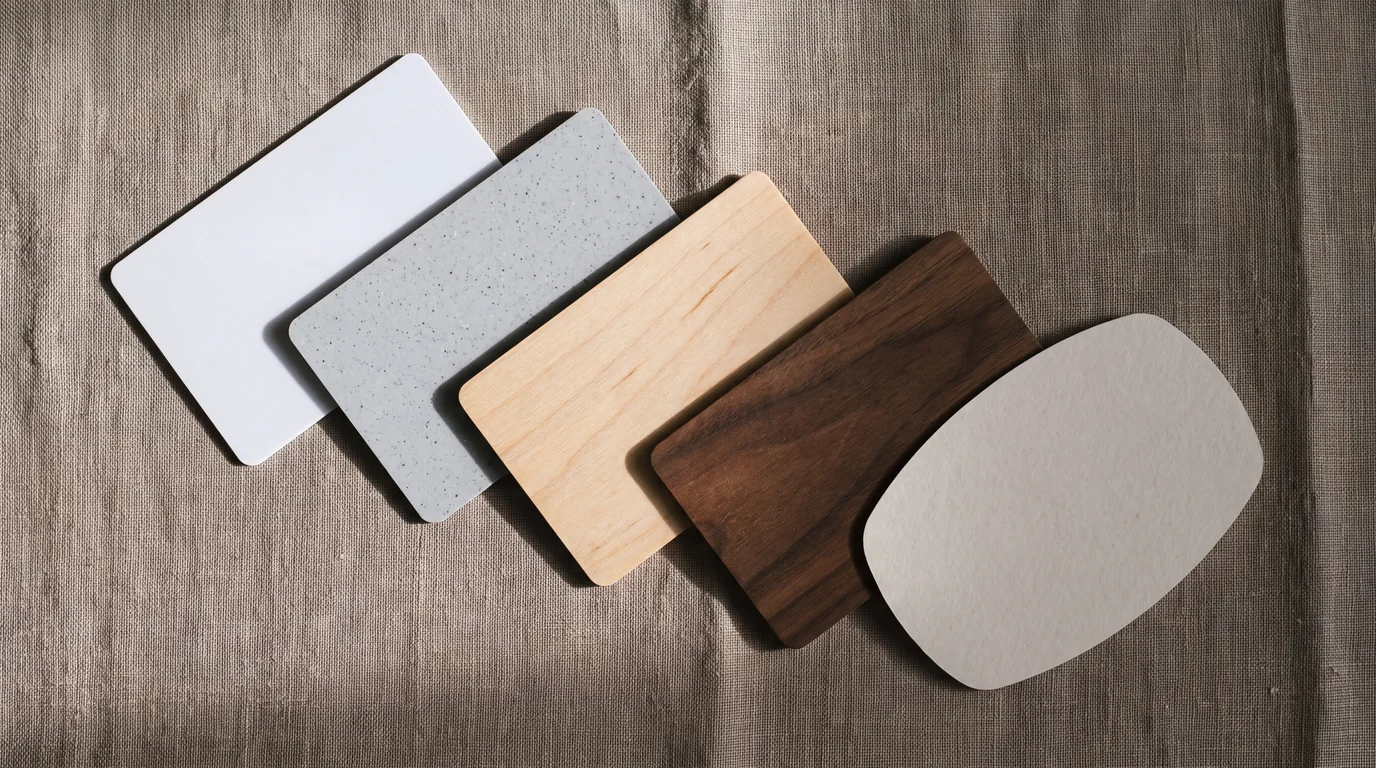
Five suppliers can answer the same enquiry for custom RFID cards and mean five different things: a logo on a white PVC body for one, a die-cut shape with a photo of every holder and a sector map written into memory for the next. The word is shorthand for ten independent decisions, and a first order usually goes wrong at the layer the buyer never knew existed. What follows is each layer in turn: the decision you own, the data you send, and what happens if you do not.
01. Why the word causes so much trouble
A quote for custom RFID cards is never priced on the word custom. It is priced on a specification. "Custom NFC cards, 2,000 pieces, with our branding" cannot start production: branding is one layer out of ten and the other nine are blank. The quote comes back on that plant's defaults, usually white PVC at 0.76 mm, ISO ID-1, gloss laminate, four colour both sides, blank chip.
If that is what you wanted, fine. If not, the gap surfaces after the sheets are printed. A spec that says default ten times is complete. One silent on encoding is not.
02. Layer one: the material and the body
What you decide. Material and thickness, which set print behaviour, finish options and how the card ages. PVC at 0.76 mm is what nearly every reader slot, wallet and printer expects. Recycled PVC runs the same on press but starts slightly off-white, so pale backgrounds shift. PET takes heavier daily use. Wood (basswood, cherry, black walnut) and bamboo behave differently: grain shows through and ink absorbs unevenly board to board.
What you send. Material, thickness in millimetres, core colour if not white, and the make of any slot, lock or printer the card must fit.
If you do not send it. White PVC at 0.76 mm, which is right most of the time and quietly wrong in hotels with older lock readers.
The limit. Unusual thicknesses, pre-coloured cores and transparent bodies are stock questions before price questions. Wood cannot be corrected by reprinting.
03. Layer two: the shape and the die
ISO/IEC 7810 defines the ID-1 format, 85.6 by 54 mm with a 3.18 mm corner radius. That outline needs no tooling anywhere, which is why every other outline costs something.
What you decide. ID-1, or a shape in one of three tiers: a punched slot or hole (a change of punch position, not a die); a shape already in the die library, such as a key tag or snap-out fob (no tooling); or a new outline (a steel die).
What you send. For a slot, the position measured from two edges, round or oblong. For a new outline, a dimensioned vector drawing at 1:1 with corner radii stated: a rendered image is not a drawing. Check what the existing tooling already covers first.
If you do not send it. ID-1 with no slot, and punching afterwards is a hand operation that risks the antenna.
The limit. A die is a tool: one-off cost, extra days on the first run, and a cut-out two or three millimetres wide will not hold in PVC. A smaller body also holds a smaller antenna, so a key tag reads at shorter range.
04. Layer three: the printed design, and what print-ready means
You decide one side or both, process or spot colour, and how close the design runs to the edge. Then you send a print-ready file, which has a specific meaning:
- Bleed. At least 2 mm of artwork past the trim on every edge, because sheets are printed then punched and the punch has a tolerance.
- Safe zone. Text and logos at least 3 mm inside the trim line.
- Resolution. 300 dpi minimum at final size. A logo pulled off a website is 72 dpi and stays 72 dpi.
- Colour mode. CMYK, not RGB. Name any Pantone separately: the same ink under PVC laminate is not the colour it is on coated paper.
- Fonts outlined. Otherwise prepress substitutes a font and nobody notices until press approval.
- Layers named. Front and back identified, with white ink, varnish and foil each on their own layer.
Without it, prepress rebuilds what it can, which is a guess at your intent. One design point: large flat dark solids show the inlay outline and lamination marks far more than lighter or textured backgrounds, so flag a deep black or navy brand early.
05. Layer four: the surface finish
What you decide. Gloss laminate is the default and the most scratch-tolerant. Matte feels better and hides fingerprints, but scuffs show more on dark colours. Matte with spot gloss on a logo is the finish usually described vaguely as premium. Frosted surfaces, signature panels and scratch-off panels are separate operations.
What you send. For spot varnish, a mask file at the artwork dimensions, 100% black where varnish goes and empty where it does not. For foil or embossing, vector shapes clear of the trim line and away from the chip module.
If you do not send it. Gloss both sides, which is what makes a matte brand palette look like a loyalty card.
The limit. Foil and embossing need a die, and foil has a minimum feature width, so fine serifs and hairlines fill in or tear.
06. Layer five: numbering, barcodes, QR and variable data
Here custom stops meaning design and starts meaning data, and both printing and inspection change with it.
What you decide. What is unique per card, and whether it must match anything else on it: sequential numbers, member IDs, barcodes (Code 39, Code 128, EAN-13), QR codes, or a combination.
What you send. A file, not a sentence. A delimited list, UTF-8, one column per field, the same number of fields on every row, no merged cells. With it: start and end values, digit count including leading zeros, any prefix, and the check digit rule. For barcodes, the symbology, module width and bar height; for QR, the content, error correction level and module size. ISO/IEC 18004 requires a four-module quiet zone, and artwork that crops into it gives a code that scans on a phone and fails on a handheld scanner. Our guide to variable data and codes covers the formats.
If you do not send it. Cards ship unnumbered, and the number sits under the laminate, so adding it later means producing them again.
The one that catches people. "The printed number should be the chip number" means reading each chip and matching its artwork. Doable, but a different job.
07. Layer six: photographs and personal data
What you decide. This is where a card becomes a record about a person. You choose whether the data goes on at the factory, under the laminate, or on your own printer later. The factory route gives the better surface; on-site lets you replace one card without an order.
What you send. One image per holder, named against the identifier printed on the card, with the crop rule, the background requirement and 300 dpi at printed size, plus one data list whose rows match the filenames exactly. One mismatch is one wrong card.
If you do not send it. Nothing proceeds. This layer has no usable default.
Agreed in writing. How the data is transferred, who at the plant can see it, and when it is deleted. Personalised cards also print one at a time, not sheet by sheet.
08. Layer seven: the chip, the frequency and the antenna
The invisible layer, and the biggest cause of failed first orders: a card with the wrong chip looks exactly like a correct one until someone holds it to a reader.
What you decide. Nothing, in the useful sense. The chip is dictated by the reader, lock or turnstile the card must open. Choosing one off a comparison table is how a box of unusable custom NFC cards gets made.
The bands are still worth knowing. 125 kHz covers read-only parts such as EM4200 and writable ones such as T5577, common in older access systems. 13.56 MHz covers MIFARE Classic, Ultralight, Plus and DESFire, NTAG and ICODE, and almost all phone-readable work. UHF is for longer-range reading.
What you send. The make and model of the reader or lock, a working card from the existing system, or a chip part number your integrator has confirmed. Any one is enough; "13.56 MHz" is not, because that band holds a dozen incompatible chips.
How we close it. You send the model, we confirm the chip in writing, and nothing goes on press until that confirmation is accepted. Chip and antenna are sealed inside the body, so there is no retrofit.
09. Layer eight: encoding, which is not the same as the chip
Two cards can carry the identical chip and behave completely differently, because the chip is hardware and the encoding is what has been written into it. Every chip leaves its maker with a UID, a fixed read-only serial, and many access systems use nothing else. Others ignore it and read user memory: a site code, a card number or a credential in a given sector.
What you decide. Blank or pre-encoded delivery. Blank means UID only and factory transport keys, with your own software doing the writing. Our guide on blank versus pre-encoded cards covers when each fits.
What you send for pre-encoding. The memory map, the data format including byte order, the access conditions, the keys if they are not default, and the UID format if UID data is used. For NDEF work, the exact URL template with any per-card parameter. For DESFire with AES keys, who generates the key and who holds the master. One known-good sample card is worth three pages of description.
If you do not send it. Cards ship blank on default transport keys: normal for an integrator, a dead end for a buyer who assumed custom included credentials.
10. Layer nine: security features, and what each one stops
Card security splits into two unrelated problems: forging the visual card, and cloning the chip. Features from one column do nothing for the other.
Visual features. UV ink invisible in daylight, microtext that survives printing but not photocopying, guilloche patterns, a holographic overlay patch, and tamper-evident laminate that delaminates if lifted. These defeat a fake card at a door and nothing else. Send UV and microtext on their own named layer, minimum point size checked.
Chip-side security. Chosen in layers seven and eight, not here. A MIFARE Classic credential read by UID is trivially copied with a cheap tool; a DESFire credential with AES keys and mutual authentication is not. If cloning is the real risk, the answer is the chip and the key management, not a hologram.
The limit. A custom hologram pattern needs its own master, so it carries tooling cost and a minimum set by the hologram supplier. A stock overlay has neither.
11. Layer ten: what travels with the card
What you decide. How the order arrives decides how much work your team does on receipt: sleeves, lanyards, clips, badge reels, holders, and how the cards are packed. If the card is worn, the slot position from layer two and the lanyard attachment must agree, checked once on the sample. Printed accessories can carry the card artwork or stay plain.
What you send. Lanyard width and attachment type, sleeve material, cards per box, whether they stay in numerical sequence, and what the box label says. Sequence packing matters when numbered cards go to named holders, and is almost never asked for until the second order. Otherwise cards arrive bulk packed.
12. What custom does not stretch to
Four things sit outside a normal first order, for the same reason: a tool has to be cut, or a supplier has a minimum of its own.
- New die shapes, foil dies and embossing dies. A physical tool: one-off cost and extra days on the first run. Reorders carry neither.
- Custom hologram patterns and antenna geometry. Minimums set by the component supplier, well above a card minimum.
- Chips outside the regular range. A part we do not stock is bought at its vendor's minimum, which can exceed your order.
- Tight colour matching on wood and bamboo. The substrate is not a uniform white base, so a Pantone tolerance routine on PVC is not achievable on grain.
None of these are refusals, only quantity and schedule conversations.
13. Technical references
- ISO/IEC 7810 defines the ID-1 format, its 85.6 by 54 mm dimensions and the tolerances that make a card fit a reader slot: iso.org/standard/70483.
- ISO/IEC 18004 specifies QR symbology: module size, error correction and the four-module quiet zone artwork must leave clear: iso.org/standard/83389.
- NXP publishes the MIFARE datasheets, the reference for what each 13.56 MHz chip can and cannot do: nxp.com/products/rfid-nfc/mifare-hf.
14. Where Kaway fits
We make custom RFID and NFC cards, ABS key fobs, wristbands and printed accessories in our own plant in Dongguan, Guangdong, with our office in Hong Kong. The plant has produced since 2007, and Kaway Group Limited was incorporated in Hong Kong in 2015. It covers 1,300 square metres with 87 people, has capacity for 8 million cards per month, and has shipped to 53 countries.
The minimum order is 500 units. Standard production is 13 calendar days, 8 on express and 12 for wood cards. Quotes are answered the same business day, with a free sample once the request is qualified. Materials: PVC, recycled PVC, PET, bamboo and wood (basswood, cherry, black walnut). Our FSC chain of custody certificate FSC-C195226 covers wood. Frequencies: 125 kHz, 13.56 MHz and UHF. Chips: MIFARE Classic, Ultralight, Plus and DESFire, NTAG, ICODE, EM4200 and T5577.
On white-label orders there is no Kaway marking on the card, the box or the documentation, and we do not approach a distributor's customers. On the layer that matters most: you send the reader or lock model, we confirm the chip in writing before production starts.
15. Frequently asked questions
Which layers can I safely leave to the factory?
Material, finish, shape and packing can run on defaults, because a wrong default there is visible on arrival and fixable next time. The chip, the encoding and the variable data cannot: those errors are invisible on arrival.
Is a custom shape expensive, or just slower?
Both, once, then neither. A new outline carries a one-off tooling cost and adds days to the first run, but once the die exists a reorder schedules like any other card.
Can you match our brand colour exactly?
On PVC we work to a named Pantone reference and approve on a printed sample. Ink under laminate does not behave like ink on coated paper, so expect a small shift. On wood, exact matching is not achievable.
Can we add numbering or encoding to cards you already made?
Encoding yes, numbering no. A chip can be written at any time, so a blank batch can be encoded later. Printed numbers sit under the laminate, so adding them means producing the cards again.
Do I need to understand all ten layers to order 500 cards?
No. You need to answer them, which is different, and most first orders are standard on seven of the ten. Send the reader or lock model, artwork with bleed and your numbering requirement, and we will flag the rest.
About this guide
Published by Kaway Group. The date on this page shows when this guide was last updated. If anything here is out of date, or contradicts what your integrator tells you, tell us and we will correct it.
Send the reader or lock model, the quantity and the date you need them. That is enough for us to answer.
Talk to us