Card sample types: ask what each sample proves
Samples answer different questions. Requesting the right type prevents a visual reference from being mistaken for a production qualification.
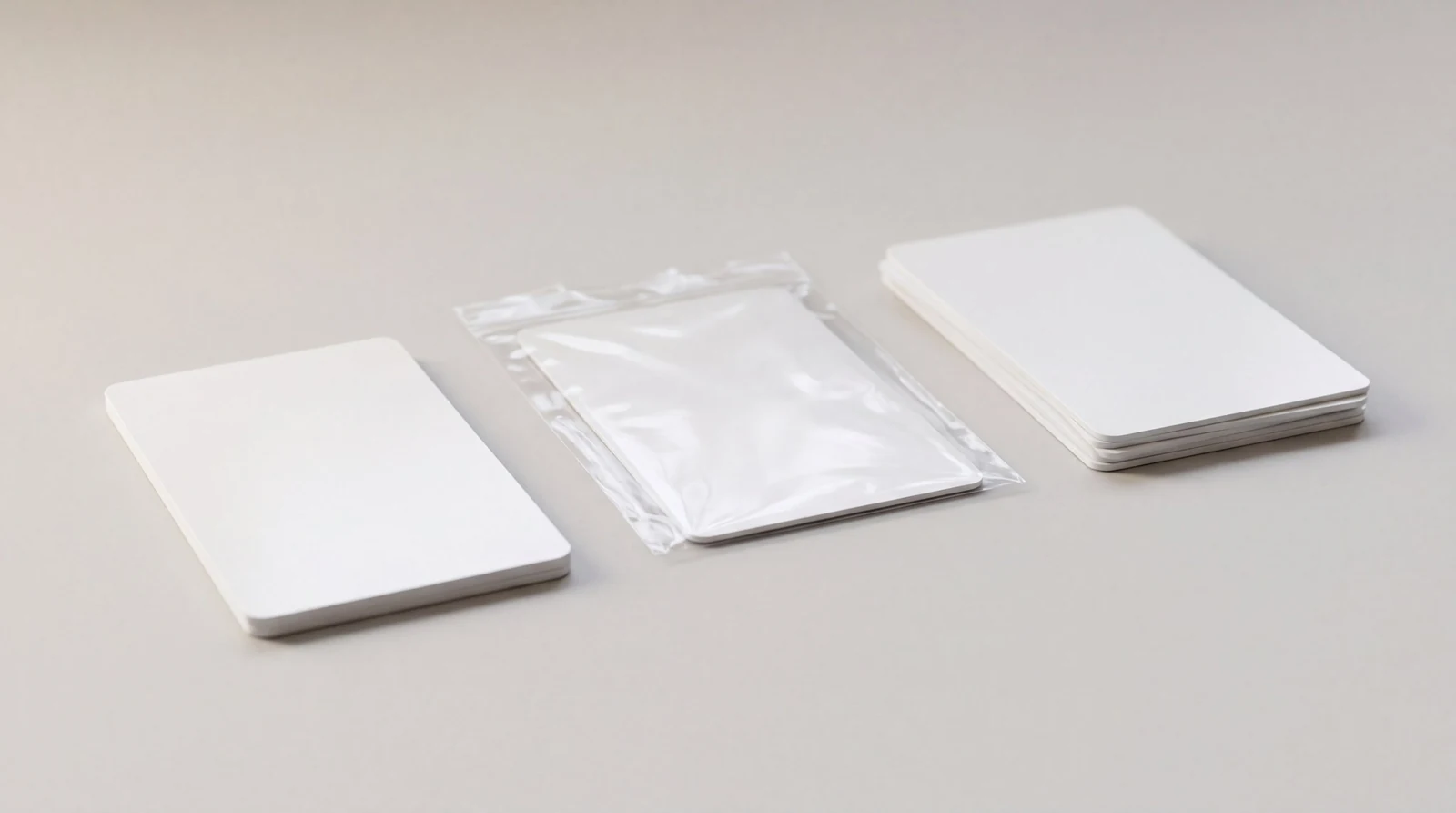
Samples answer different questions. Requesting the right type prevents a visual reference from being mistaken for a production qualification.
Card suppliers use the word sample for at least three different objects. One is a stock card pulled from a drawer to show what a matt laminate looks like. One is a printed proof made from the buyer's own file. One is a card built to the proposed construction, with the proposed chip, encoded the way the order will be encoded. The three cost different amounts, take different lengths of time, and support completely different decisions.
The Kaway sample ladder is three rungs: catalogue reference, artwork proof, production-representative sample. Each rung answers one question, and nothing on an upper rung is evidence for a question that belongs on a lower one. Most sample disputes in card procurement are a buyer treating a rung-one object as rung-three evidence, in good faith, because nobody wrote down which rung it was.
01. A sample is evidence, and each type proves something different
A sample is evidence for one question, not a general endorsement of the supplier. Once a sample is treated as evidence, the next question answers itself: evidence of what? A catalogue reference is evidence about a process, not about the job, because it was not made for the job.
A production-representative sample is evidence about the proposed order. It carries the construction, the chip part number and the encoding scheme the run will carry, so it is the only object on the ladder that can support a reader or lock trial. Everything between those two poles is a partial answer, and knowing which one is on the desk is what stops a partial answer being filed as a complete one.
02. The catalogue reference proves process and finish, nothing else
A catalogue reference settles appearance and feel, and should be requested early for exactly that. It removes a whole class of argument about what a finish looks like, which no screenshot resolves.
The failure mode is predictable. A buyer receives an attractive reference card, likes the weight and the print density, and carries that impression into an approval months later. The reference had a MIFARE Classic EV1 1K chip and the order specifies MIFARE DESFire EV3; the reference was 0.84 mm and the order is a standard ID-1 body at 0.76 mm. Neither difference is visible, both are material, and neither was written down.
Two habits remove the problem. Ask what the reference card actually is, line by line, and record the answer beside it. Then ask which of its characteristics are not representative of the proposed order, which is the same question from the other side and usually produces a more honest list. Specifying a card order covers the specification lines those answers are compared against.
03. The artwork proof settles the print, not the construction
An artwork proof is evidence about the printed surface: colour against the agreed reference, the position of the design inside the trim, fine type near the bleed, and the legibility of variable data such as a serial number or a barcode. Where a brand owner sits in the approval chain, this is the sample that protects the relationship.
An artwork proof is frequently made on a body that differs from the order: plain white PVC with no inlay, because an inlay adds cost and time to a proof whose purpose is colour, or a digital proof on a substrate chosen for colour accuracy. Both are legitimate, and both mean the proof says nothing about thickness, lamination, read range or durability.
The approval wording matters here more than anywhere else. An approval that reads approved is read later as approval of the card. One that reads artwork revision C approved for colour and position, construction not represented, survives a change of buyer and eighteen months.
04. The production-representative sample is the only one that supports a functional test
A functional test is valid only on a sample built like the order. Read range, lock behaviour, antenna tuning inside the finished laminate and encoding on the actual chip all depend on construction, which is precisely what the earlier rungs do not reproduce.
For an RFID or NFC card this is not a preference, it is physics. An antenna tuned inside a 0.76 mm laminate behaves differently from the same antenna in a thicker body, and a frosted or metallised layer in the build changes the result again. A card that reads cleanly on a desktop reader and fails at a door reader has usually been tested in a form that the delivered card does not share. Card antenna and read range sets out which construction variables move that measurement.
Encoding belongs in the same sample. A buyer running cards on a hotel lock platform needs the chip, the key structure and the data layout proved together on the proposed card, not on a near relative of it. Blank or pre-encoded cards covers where that step sits and who holds the keys.
Even a production-representative sample has a limit worth naming. It is one card, or a handful. It shows the construction can be produced and can pass the tests. It does not show that fifty thousand will be uniform: that is a question for incoming inspection, covered by the card delivery inspection checklist and by the plastic card quality control plan.
05. Name the purpose of the sample before it is requested
The purpose decides the type, so the purpose is written first. A request that says please send a sample invites the supplier to choose, and a supplier choosing without a stated purpose will send the fastest and cheapest object that satisfies the word.
Three sentences are enough. State the decision the sample has to support, such as choosing a finish or passing a door reader trial at the client's site. State which characteristics must be representative: chip part number, body thickness, encoding. State the date the decision has to be made.
06. Record the approval and the commercial terms
A sample approval is a document, not an email thread. It is short, and the discipline is in writing the negative lines rather than the positive ones.
Sample costs and carriage vary by supplier, by construction and by whether the request is tied to a quantified enquiry. A reference card from stock and a tooled sample in a special shape are not comparable commitments. Agree cost, carriage and timing in writing, before the work starts rather than when the invoice arrives.
The approval record ties the approved object to a revision. Without that tie, a later run that differs from the approved sample cannot be shown to differ, because nobody can say which object was approved. The card supplier qualification record applies the same principle one level up, to approving a supplier's construction rather than a single job.
07. The buyer checklist
Before the request goes out
- The decision the sample has to support, written in one sentence.
- The characteristics that must be representative: chip part number, construction, thickness, encoding, finish.
- The date the decision has to be taken.
- Who at the buyer's end signs the approval.
Before approval is given
- Sample type, named: catalogue reference, artwork proof or production-representative.
- Construction differences from the proposed order, listed one by one.
- Test scope: what was tested, by what method, and what was not tested.
- Agreed cost, carriage and the date the sample was issued.
- The artwork and job revision the sample was built from.
- The gates still open before production release.
08. Worked example
Illustrative scenario, not a Kaway case study. A distributor specifying 12,000 cards for a hotel group moving from magnetic stripe to contactless asks the manufacturer for a sample.
What arrives is a handsome card: a matt body, a spot UV panel over the logo and a clean edge. The distributor approves the look, forwards a photograph to the end client and books the order. The reference was built on a MIFARE Classic EV1 1K inlay at 0.84 mm, the construction the supplier keeps in stock for finish references. The order is MIFARE DESFire EV3 at 0.76 mm, encoded for the client's lock platform.
The delivered cards look identical to the reference and read correctly at the front desk encoder. Two of the forty guest room locks in the oldest wing read them intermittently: the thinner body and the new chip together shift the margin at readers that were already marginal. Nothing was manufactured wrongly. The trial that would have caught it was never run, because the only card available to run it on was a finish reference.
The version that works is unglamorous. The finish reference settles the look first. A production-representative sample in the ordered construction and chip, encoded for the platform, then goes to the property for a door trial on the oldest wing. The approval record names both objects, what each proved, and the trial as the open gate.
09. Technical references
- ISO/IEC 7810 sets the ID-1 physical characteristics that a sample still has to meet whatever its purpose, which is why a body thickness difference between a reference and an order is a specification difference and not a detail: iso.org/standard/70483.html.
- ISO/IEC 10373-1 defines the test methods for the general characteristics referred to above, and is the reason a test scope on a sample approval can be written as a method rather than as an opinion: iso.org/standard/70482.html.
10. Where Kaway fits
Kaway manufactures in-house in Dongguan, China. Ask for a free sample in your material and chip to test it first. That is the rung-three object above rather than a finish reference, which is why it is worth asking for by name.
Encoding is done at the plant, across EM4200, T5577, MIFARE Classic EV1 1K and 4K, MIFARE Ultralight EV1, MIFARE DESFire EV2 and EV3, NTAG213, NTAG215 and NTAG216, ICODE SLIX, and UHF Impinj Monza and Alien H3, so a sample can be issued encoded rather than blank. Coding for VingCard, SALTO, dormakaba, Onity and Saflok systems depends on the chip and on the technical requirements, keys and authorisations of the system or the property. Every chip is read-tested individually before shipping, 100 per cent and not sampling, which is the batch-level check that a single approved sample cannot provide.
Minimum order is 500 units. Standard production is 12 calendar days for PVC and wooden cards. Quote requests are answered the same working day. Comparing card quotations on the same specification covers where sample charges belong in a quotation.
Send Kaway Group your specification and required delivery date to discuss the proposed order.
11. Frequently asked questions
Can we get a free sample?
Yes. Ask for a free sample to test it first. What changes is the type: a reference card from stock, a sample in your material and chip, or, on long runs, the first pieces of the run sent to you to check before the rest is made. Confirm which one the request needs, and its timing, so the sample answers the question you actually have.
Can a finish reference be used for a lock trial?
No, unless its construction and chip match the proposed order, which a finish reference usually does not. A lock or reader trial measures radio behaviour inside a finished laminate, so it is valid only on a card built like the delivered one.
Does an approved artwork proof approve the card?
Only the printed surface, and only for the revision it was made from. Write the limit into the approval itself: artwork revision approved for colour and position, construction not represented. An approval recorded as approved on its own is read later as approval of everything.
Who keeps the approved sample?
Both sides keep one. A retained sample at the buyer's end turns a later disagreement into a comparison, and reordering so that batch two matches batch one covers how it is used on the following run.
About this guide
Published by Kaway Group. The date on this page shows when this guide was last updated. If anything here is out of date, or contradicts what your integrator tells you, tell us and we will correct it.