Hotel key card compatibility: what actually decides whether the door opens
Why the lock brand never specifies the card, the four variables that decide whether a credential authenticates, and what to establish before ordering.
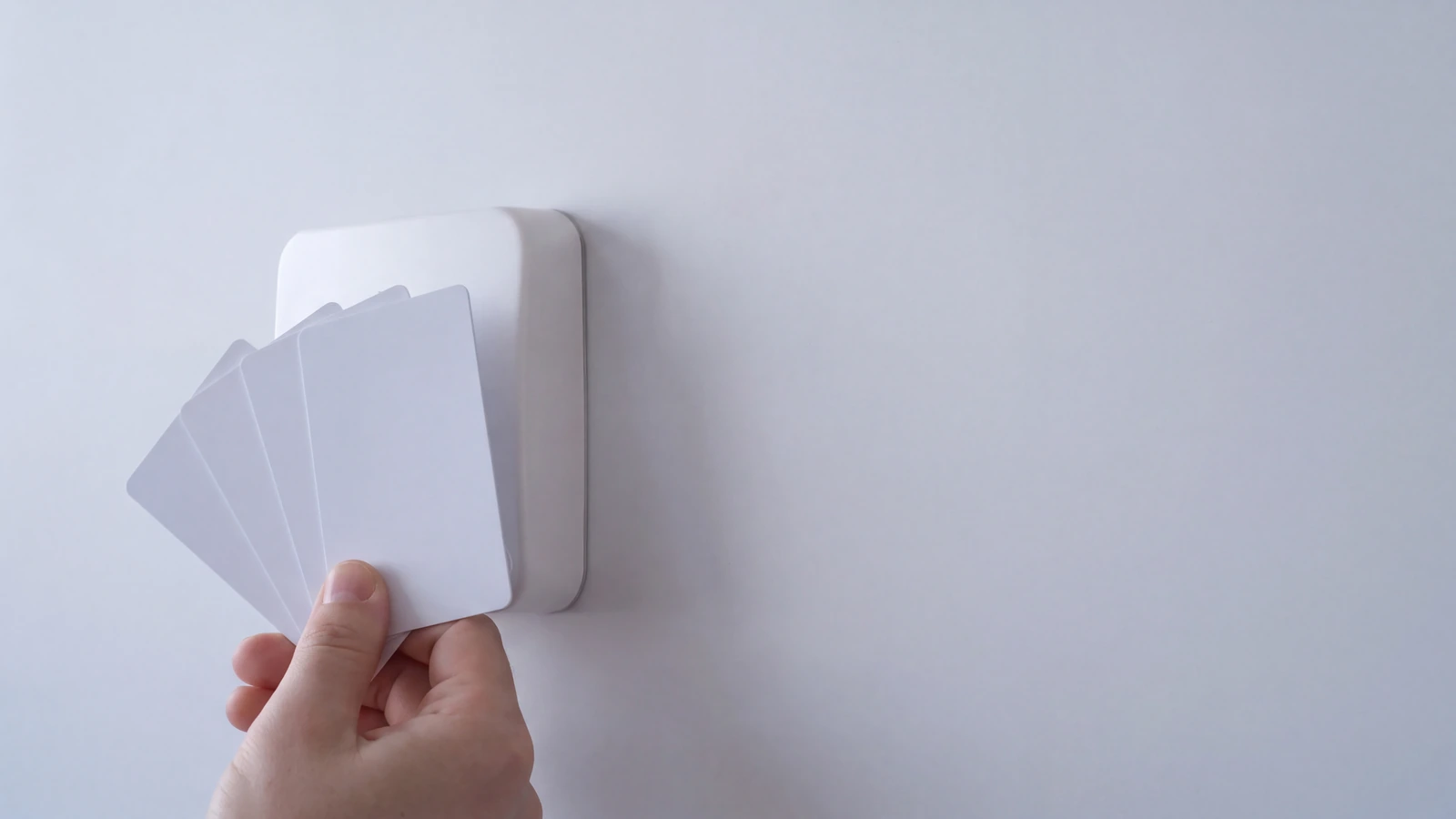
Every hotel credential order starts with the same question, and it is almost always asked the wrong way round. The question that gets asked is "do these cards work with Onity?". The question that decides whether the order succeeds is "what exactly is the reader expecting to see when the card is presented?".
Those are not the same question. A lock brand is not a specification. Two properties running the same brand, commissioned three years apart, can need different cards.
This guide is written for the person who has to specify the credential: the integrator, the distributor, the trade printer, or the facilities lead at a group. It covers what actually determines compatibility, what to establish before a purchase order goes out, and what a manufacturer needs in order to get the first sample right instead of the third.
01. The brand of the lock does not specify the card
A hotel lock system has several layers, and the card only has to satisfy some of them. The brand name on the escutcheon tells you almost nothing about the layer that matters.
What the brand does tell you
It narrows the likely radio technology and the likely chip family. If someone says Salto, you can be confident you are in 13.56 MHz territory. If someone says Onity and the card has a black stripe on the back, you are looking at magnetic stripe, not RFID at all.
What the brand does not tell you
It does not tell you the chip, the memory layout, the security mode, or the keys. All four are set when the property's system is configured and encoded, not when the lock is manufactured. The same brand can be deployed with a low-security legacy chip in one hotel and an AES-encrypted credential in another.
The card has to match the configuration, not the logo
This is why "compatible with Onity" is a marketing claim rather than a technical one. A card is compatible with a specific system, in a specific encoding mode, holding specific keys. Anything less precise is a guess that someone pays for later.
02. The four variables that decide compatibility
Whatever the brand, compatibility comes down to four things. Get all four right and the card opens the door. Get any one wrong and it does not, regardless of how good the card is.
1. Frequency
Low frequency at 125 kHz and high frequency at 13.56 MHz are different radio technologies. They are not interchangeable and no amount of encoding fixes a frequency mismatch. A 125 kHz card presented to a 13.56 MHz reader is invisible to it. Properties that run both, usually because they upgraded part of the estate, need a dual frequency card with two independent transponders.
2. Chip family
Within 13.56 MHz there are several families that are not compatible with each other at the application level even though they share the radio layer. MIFARE Classic, MIFARE Ultralight, MIFARE Plus and MIFARE DESFire all answer an ISO/IEC 14443 Type A reader, but they organise memory differently and authenticate differently. A reader configured to read a DESFire application will not accept a Classic card. What each family actually does is set out in the guide to choosing the chip.
3. Memory structure and encoding
Two cards with the same chip can still behave differently if the data is written in a different place or a different format. Sector layouts, file identifiers and block structures are set by the lock system's own software. This is the layer where most surprises happen.
4. Keys
On any system with real security, the reader will only talk to a card that holds the correct keys. Keys belong to the property, not to the card manufacturer. In practice this means a factory delivers cards that are either blank and encodable on site, or pre encoded from a key file the property supplies through the proper channel.
03. What each family of system usually needs
The following is what we see in practice across the systems we supply for. Treat it as the starting point of a conversation with the property's integrator, not as a substitute for it.
ASSA ABLOY: VingCard, Visionline and Signature
Almost always 13.56 MHz on current installations. Older Signature estates are frequently magnetic stripe. Visionline deployments have been moving to AES encrypted credentials, and that migration is the single most common reason a hotel's existing card stock stops working after a software upgrade. If the property mentions Visionline 1.30 or later, assume the encryption question is live and confirm it before ordering. What changes and what to test is covered in the Visionline AES guide.
dormakaba and Saflok
Both magnetic stripe and RFID estates are still in service, often in the same group. RFID deployments sit at 13.56 MHz. The practical risk here is a property that describes itself as "Saflok" without knowing whether its floor is on the legacy or the RFID generation. A photograph of the reader face usually settles it in one message.
Onity
A large installed base of magnetic stripe alongside newer 13.56 MHz systems. Onity is the system where the magnetic stripe question comes up most often, and where getting the track layout and coercivity right matters as much as the chip does.
Salto
13.56 MHz throughout. Salto estates are frequently mixed use, with the same credential opening guest rooms, staff doors and back of house. That matters for the card body as much as the chip: a credential carried on a lanyard all day is not the same product as one that lives in a wallet for two nights.
Häfele Dialock
13.56 MHz. Commonly deployed in properties that also use Dialock for furniture and locker hardware, so the same credential may need to work across more reader types than a guest room system.
If nobody at the property knows the answer
That is common and it is not a problem. The property's lock integrator knows, and the encoder software itself reports the credential type. A card that is already working can also be read and identified. Any of these three routes is faster than guessing.
04. The magnetic stripe case, which is not obsolete
A significant share of hotel doors worldwide still open with a magnetic stripe, and those properties are often the ones least well served, because most manufacturers have moved on. If that is your system, three things matter.
Coercivity
High coercivity at 2750 Oe resists accidental erasure far better than low coercivity at 300 Oe. Hotel environments are full of phone magnets and bag clasps. For guest cards, high coercivity is almost always the right answer.
Track layout
Which of the three tracks the system writes to, and in what format, is set by the lock software. Ordering a stripe on the wrong track produces a card that encodes cleanly and opens nothing.
Stripe position
Distance from the card edge is standardised, but artwork that runs to the edge can interfere with the encoder's read if the stripe is applied over printing rather than under the overlay. This is a manufacturing decision, not a design one, and it should be raised before artwork is approved. The stripe itself is a standard option on PVC and recycled PVC cards, on its own or alongside a chip.
05. What to send before you order
Every question below exists because the answer prevents a reprint. When we quote, this is what we ask for.
The system, as precisely as you can state it
Brand, product line and software version if you have it. "Onity" narrows it a little. "Onity Advance, RFID readers installed 2019" narrows it enough to be useful.
A working card, or photographs of one
A sample of a card that currently opens the doors is the single most useful thing you can send. It can be read, identified and matched. If you cannot send one, photographs of both faces and of the reader itself are the next best thing.
Whether cards will be encoded on site or by the factory
Most properties encode on site with their own system, which means the factory ships blank cards of the correct type. Some want cards pre encoded, which is one of the personalisation and encoding steps we run in house. If it is the second, keys have to be transmitted through a channel the property is comfortable with, and that is a conversation to have before quoting, not after.
Quantity, material and finish
Quantity drives the price break. Material drives the feel and the sustainability story, and the trade offs between PVC, recycled PVC and wood are worth settling before artwork starts. Finish drives the lead time. Wooden cards, for example, run twelve days at our plant against thirteen for a standard PVC run, but they carry different artwork constraints because the grain shows through.
Artwork, or a rough of it
A rough is enough to quote. Print ready files can follow. What we need to know at quoting stage is whether the design runs to the edge, whether there is foil or embossing, and whether anything has to be variable per card. The full list of what a factory needs, and why, is in the guide to specifying a card order.
06. The test protocol before a full run
No serious order should skip this, and the cost of doing it is a few days.
Approve a physical sample first
Colour on screen is not colour on PVC, and it is certainly not colour on walnut. Nothing goes on our line until a sample is approved, and where the request is qualified the sample is free.
Test the sample on the actual doors
Not one door. Test a guest room, a staff door, a lift reader and any back of house reader that the credential has to work with. Firmware can differ between reader generations inside the same property, and a card that works on floor three and fails on floor eleven is telling you something important.
Test after encoding, not before
A blank card that reads correctly proves the chip is right. It does not prove the encoding is right. The meaningful test is a card encoded by the property's own system and presented to the property's own lock.
One card, three different tests
Reading at the encoder proves the chip. Opening one door proves the configuration. Opening doors across every zone and every reader generation proves the order. Only the third one is worth committing a full run to.
07. What this means for specifying
Compatibility is not a feature that gets bought. It is a match that gets established, and establishing it takes one exchange of messages when the right information is on the table, or three rounds of samples when it is not.
The cost of the first route is an email. The cost of the second is a reprint, a delayed opening and a conversation with a client about why the cards do not work. That asymmetry is the whole argument for doing the identification properly before the order is placed.
Where Kaway fits
We manufacture credentials for the trade: distributors, trade printers, integrators and programme owners. We do not sell to your customers. What we make ships under your brand, with no marking of ours on the product, and the material data sheets and certifications in the delivery dossier carry your brand too.
The systems we currently supply for include ASSA ABLOY VingCard, Visionline and Saflok, dormakaba, Onity, Salto and Häfele Dialock, across hospitality and general access control work. Minimum order is 500 units. Standard production is thirteen calendar days from artwork approval to dispatch, eight on an express run and twelve on wooden cards. Quotes come back the same working day, including the ones where the answer is no. The rest of the commercial detail sits on the FAQ.
08. Frequently asked questions
Can one card work with two different lock systems?
Sometimes. If both systems read the same chip and the same data, yes. If one is 125 kHz and the other 13.56 MHz, you need a dual frequency card with two transponders, which is a standard product. If both are 13.56 MHz but use different chip families, usually no.
Our cards worked and now they do not. What changed?
Almost always the system, not the cards. A software or firmware upgrade can change the credential the readers expect, most commonly by introducing or tightening encryption. The cards did not degrade, the requirement moved.
Do you supply cards already encoded?
We can, but most estates encode on site with their own system and their own keys, and that is usually the better arrangement. Keys belong to the property, and the fewer places they exist the better. Where a partner handles encoding as part of their own service, we ship blank stock of the correct type.
Is a wooden card compatible with the same systems as PVC?
Yes. The chip and antenna are the same components; the body material is different. Read performance is equivalent for practical purposes. What changes is thickness tolerance and artwork, not compatibility. What a wooden card does and does not change is covered separately.
What if we do not know our system at all?
Send a photograph of the reader and of an existing card, front and back. Between the two, the system is usually identifiable. If it is not, the property's integrator can confirm it in a single email.
Send the reader or lock model, the quantity and the date you need them. That is enough for us to answer.
Talk to us