Card thickness and lamination: 0.40 to 1.0 mm, and why cards fail
What the five layers of a card actually are, why 0.76 mm is the number every encoder is built around, and the four ways a card fails in the field.
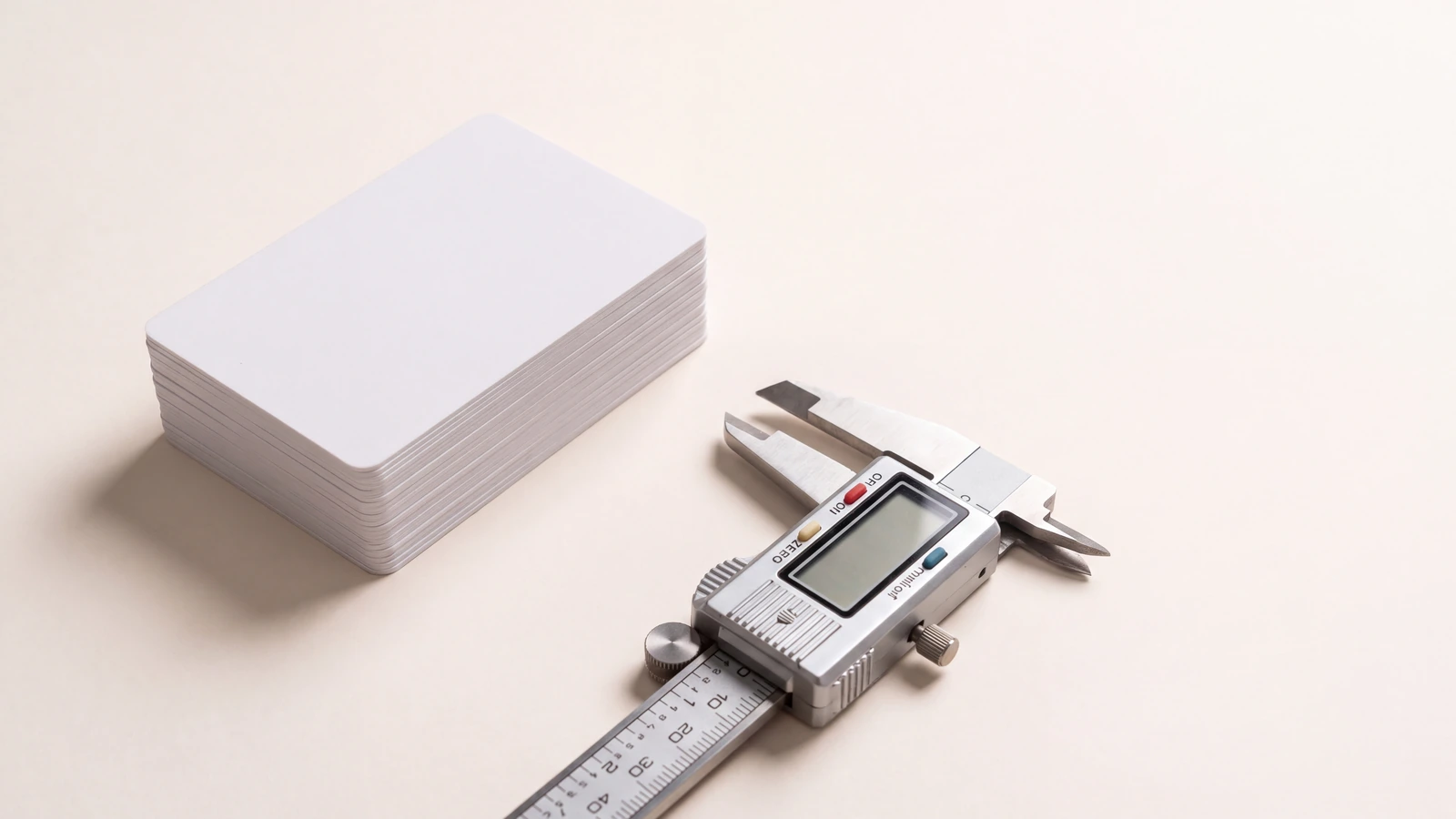
A card looks like a piece of plastic. It is a stack of five, fused under heat and pressure, and almost everything that goes wrong in the field is a place where that fusion was incomplete or was later broken.
Thickness gets specified casually, usually by copying whatever the last order said. It is worth more attention than that, because the number decides whether the card fits an encoder, a holder and a wallet, and how long it survives.
The two subjects belong in one guide because they are the same subject seen from two ends. Thickness is what the stack adds up to; lamination is what holds the stack together. Specify the first without understanding the second and you end up with a card that is the right size and falls apart, which is the more expensive of the two failures because it happens after the cards are in circulation.
This guide is for whoever writes the specification: a trade printer, a distributor, an integrator or a programme owner.
01. What a card is made of
Five layers, in a fixed order, pressed together in a lamination press.
Two things follow from the diagram and both matter commercially. The first is that the print is protected, not exposed. The second is that the inlay is in the middle, so anything that presses on the card from outside, an embossed character, a hot foil block, a punched slot, has to avoid the area where the chip and antenna sit.
This is the difference between a laminated card and a desktop printed one, and it is worth explaining to a client who is comparing prices. A card printed on a desktop machine has its image on the surface, under a thin ribbon overlay at best. A laminated card has its image sealed between layers of PVC. The first looks equivalent on the day it is issued. Six months later, in a pocket, they are not the same product.
02. The number that matters is 0.76 mm
ISO 7810 defines the ID-1 format as 85.60 by 53.98 mm, 0.76 mm thick. That thickness is not a style choice. Every encoder feed, every card printer, every wallet slot and every card holder in the world is built around it.
Below 0.76 mm
Thinner cards are cheaper and lighter and are right for anything short lived or handed out in large numbers. They flex more, which means the area around the chip works harder, and they will not run through a card printer designed for the standard.
Above 0.76 mm
Thicker cards feel substantial and leave room for a larger inlay. They also stop fitting standard holders. Wooden cards sit outside the range entirely at 1.20 to 1.30 mm, which is a real operational consideration rather than a detail, and it is covered in the guide to wooden cards.
Ask the encoder, not the designer
If the card has to pass through a printer, an encoder or a dispenser, that machine sets the thickness and there is no discussion to have. Specify anything else only where the credential is handled by people rather than by machines.
One practical test settles most of these conversations. Ask what machine the card has to go into, and whether anybody has tried a non standard thickness in it before. If the answer is a hotel encoder, a desktop card printer or a vending style dispenser, the thickness is decided. If the card is only ever handled by people, tapped on a wall reader and carried in a wallet, there is room to choose.
03. What lamination actually does
Heat, pressure and time. The stack goes into a press, the PVC softens, the layers flow into each other, and then it cools under pressure so the bond sets. Three variables control the result: the temperature, the pressure, and the dwell time.
Get them right and you have one piece of plastic. Get the dwell time slightly short and you have five layers that are stuck together rather than fused, which looks identical on day one and separates in month four. This is why a sample proves colour and feel but does not prove durability, and why the lamination recipe is one of the things worth writing into the specification record for the next order.
The cooling stage deserves a mention of its own, because it is the one most often rushed. A stack pulled out of the press while still warm relaxes, and the internal stress that leaves behind is what turns into a curve on a warm day months later. Cooling under pressure is not a finishing touch; it is half the process.
How to test a sample properly
Because none of this is visible at delivery, the only useful sample test is a deliberately abusive one. Flex a card fifty times along its long axis and look at the area over the chip. Leave one on a windowsill in the sun for a week. Carry one in a back pocket for a few days. Try to lift a corner of the overlay with a fingernail. Five minutes of effort spread over a week tells you more about a supplier than any specification sheet.
04. Four ways a card fails
Edge delamination
The overlay lifts at a corner and the card starts to peel. Almost always a lamination problem, and almost always visible first on cards that live in a pocket with keys.
Cracking at the chip
The chip module is the stiffest point in an otherwise flexible card, so repeated bending concentrates there. Worse on thin bodies, worse again where the card is carried in a back pocket. It is also the failure most often blamed on the chip when the cause is the body: the silicon is fine, the connection between module and antenna is not.
Print wear
The image fades where the card is gripped. A thin overlay, or no overlay at all on a surface printed card, and the card looks tired in months.
Warping
PVC softens well below its melting point. A dashboard in summer, a pocket next to a body all day, a hot wash, and the card takes a curve it does not lose. A warped card often still reads, but it stops feeding through machines, which is a different and more annoying kind of failure. PET handles heat considerably better, which is usually the reason it gets specified.
05. How to specify it
- Thickness, and whether the card has to pass through a printer or dispenser.
- The core: standard PVC, recycled PVC, PET, or a wooden body.
- Overlay, gloss or matt, and on one or both faces.
- Anything pressed: embossing, foil, slots, and whether it can clear the inlay.
- The environment: pocket, wallet, lanyard, vehicle, wet area.
The last line is the one most often left out and the one that predicts the most failures. A card that lives on a lanyard around a neck all day is a different product from one that lives in a wallet and comes out twice a week, even though the specification sheet looks the same. Say where the card lives and a manufacturer can tell you which of the four failure modes is the one to design against.
06. Where Kaway fits
We manufacture for the trade and do not sell to your customers. PVC and recycled PVC cards from 0.40 to 1.0 mm are printed, laminated, die cut, personalised and encoded on one floor, which is what makes the lamination recipe something we can reproduce on a reorder rather than rediscover.
Minimum order is 500 units, standard production thirteen calendar days from artwork approval to dispatch, eight on the express route, and quotes come back the same working day. Where the request is qualified we will send a free sample, and the honest advice is to treat it roughly for a week before deciding. What a factory needs in order to quote is in the guide to specifying an order.
07. Frequently asked questions
What thickness should I order?
0.76 mm unless you have a specific reason not to. It fits every machine and every holder, and departing from it should be a decision rather than an accident.
Can a thin card carry a chip?
Yes, down to about 0.50 mm comfortably. Below that the inlay choice narrows and the card flexes enough that the area around the chip becomes the weak point.
Why did our last batch start peeling?
Lamination, in almost every case. Temperature, pressure or dwell time slightly off. It is a process problem rather than a materials problem, which is why it can appear on one run and not the next from the same supplier.
Does a recycled core laminate the same way?
Yes. Same process, same equipment, same result. What a recycled core does and does not change is covered separately.
Can you match the thickness of our existing cards?
Send one. Measuring it and matching the stack is straightforward, and it removes the single most common source of a card that suddenly will not feed.
Is a matt or a gloss overlay more durable?
Gloss hides scratches better because it reflects unevenly. Matt shows wear sooner but hides fingerprints, and it is usually chosen for how it looks rather than how it lasts. Neither changes the structural durability of the card, which is decided in lamination.
Can a card be thicker on one side than the other?
No, and a card that measures differently at one edge has a lamination problem. Uneven thickness is one of the few defects a caliper gauge finds immediately, which is why checking a few cards from a delivery is worth doing.
Does embossing weaken a card?
It displaces material rather than removing it, so the card is not thinner, but the embossed area is stressed and it has to clear the inlay. Send the embossing positions with the artwork so the inlay layout can be chosen around them.
Send the reader or lock model, the quantity and the date you need them. That is enough for us to answer.
Talk to us