Specifying a card order: MOQ, lead times, artwork and sampling
Minimum order quantity, lead times in calendar days, the five artwork mistakes that cause reprints, sampling rules and the HS heading a card clears under.
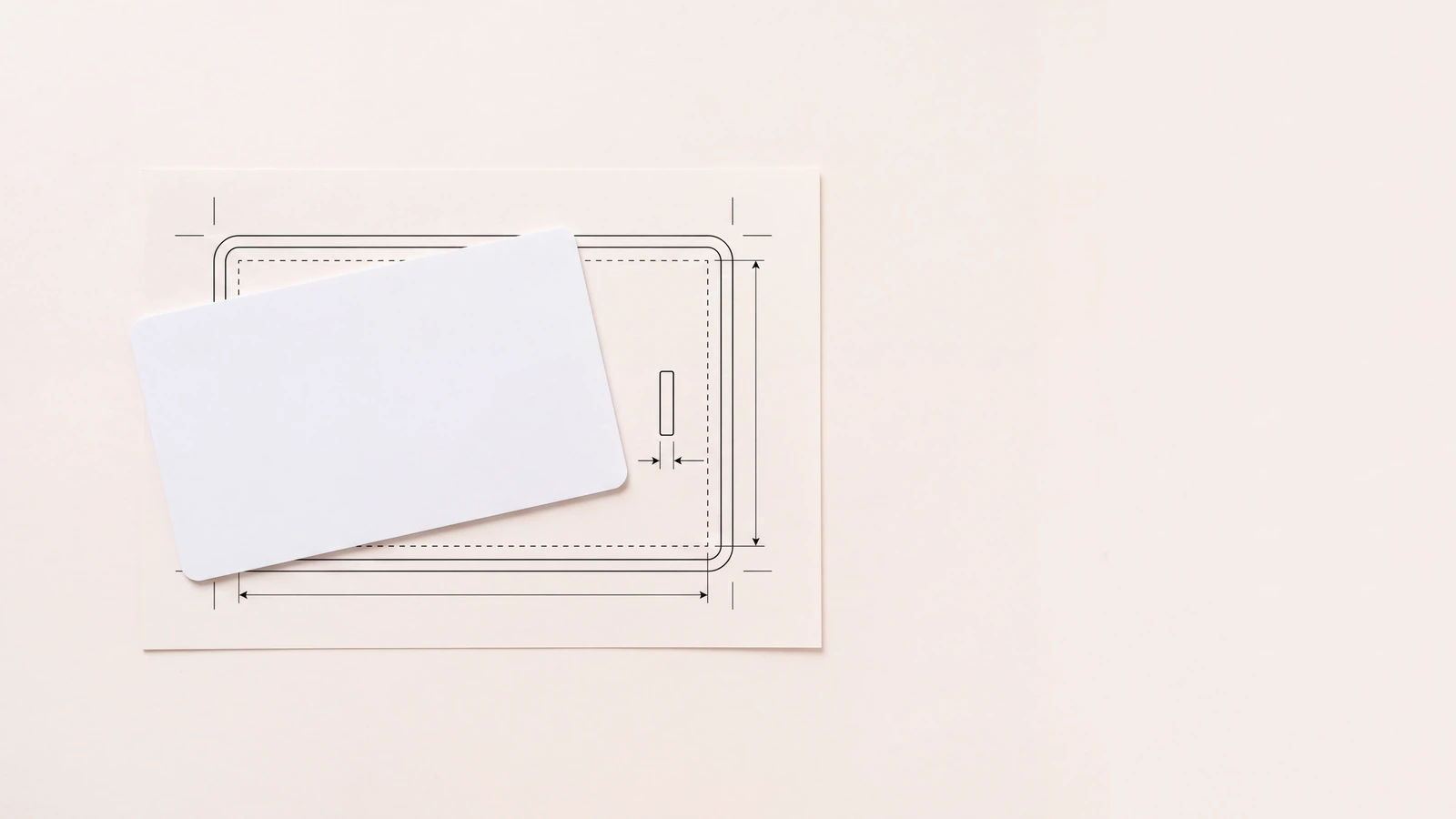
Card manufacturers publish a great deal about what they can make and almost nothing about how to order it. Minimum quantities, lead times, artwork requirements and sampling rules are the four things every buyer needs before they can commit, and they are the four things that usually arrive only after a form has been filled in and a salesperson has called back.
This guide states them plainly. It is written for the person assembling a specification to send to a factory: a distributor pricing a job for their own client, a trade printer adding credentials to a print order, an integrator scheduling around an installation date, or a programme owner placing a first volume order.
Where we give our own numbers, they are ours. Other manufacturers will differ, and the point of publishing them is so you can compare rather than guess.
01. Minimum order quantity, and what it is actually for
A minimum order is not a commercial hurdle. It is the point below which setting up the line costs more than the cards.
Where the setup cost sits
Printing plates or a digital colour profile, an inlay layout for the chosen chip and antenna, lamination plate setup, die tooling for the format, and a first article check. Those costs are identical whether the run is 500 cards or 50,000. Below a certain quantity they dominate the unit price to the point where the number stops being useful to anybody.
Our number
Five hundred units. If a project sits below that, ask anyway. There are cases, a pilot before a rollout, a replacement batch for an existing programme, where it makes sense on both sides and we will say so.
What changes as quantity rises
The first meaningful break is where the run fills a sheet without waste. The second is where a colour setup is amortised across enough cards to stop mattering. Beyond that, price moves slowly. A buyer expecting the curve to keep falling steeply at high volume is usually disappointed, and it is better to say that before the negotiation than after.
The quantity question that actually matters
Not "what is your MOQ" but "at what quantity does this stop being expensive per unit". Those are different numbers, and the second one is the one that should shape the order.
02. Lead times, stated as calendar days
Lead times in this industry are quoted inconsistently, sometimes in working days, sometimes from order date, sometimes from artwork approval, which makes comparison between quotes almost meaningless. Ours are calendar days from artwork approval to dispatch.
The three figures
Thirteen calendar days on a standard run. Eight on an express run. Twelve on wooden cards, which are faster than standard PVC because the material sequence is different, not because they are simpler.
What the clock does not include
Two things, and both are usually where schedules actually slip. The first is the time between a quote being accepted and artwork being approved, which is entirely in the buyer's hands and routinely takes longer than production. The second is transit, which depends on destination and mode.
How to protect a date
Work backwards from the date the cards have to be in the client's hands, subtract transit, subtract production, and the number you are left with is the real artwork deadline. Most late deliveries are artwork approvals that slipped by a week against a production schedule that never moved.
03. Artwork, and the five things that cause reprints
A card is not a small poster. The constraints are specific and they are not obvious to a designer who has not made one before.
1. Bleed and safe area
Cards are printed on a sheet and then die cut, and the die has a tolerance. Artwork needs bleed beyond the trim line, and anything that must not be cut, logos, text, borders, needs to sit inside a safe margin. A design with a thin frame parallel to the edge is the single most common cause of a batch that looks misaligned, because any drift shows immediately against a straight line.
2. Colour, and what happens on PVC
Supply CMYK, not RGB, and expect that a screen and a laminated PVC surface are different substrates. Deep blacks, bright oranges and metallics behave differently from what a monitor shows. If a brand colour is critical, specify a Pantone reference and ask for it to be matched on the physical sample rather than approving a PDF.
3. Resolution and vectors
300 dpi minimum for raster elements at final size. Logos and type as vectors wherever possible, because a card is small and any softness in a logo is visible at the distance a card is actually held.
4. Where the chip and antenna sit
The inlay occupies a defined area inside the card body. Deep embossing, a punched slot, a hole for a lanyard, or hot foil over the antenna area all have to be positioned around it. This is worth raising at the quoting stage, not after artwork is approved, because it can change the design. It matters most on special shape cards, where the outline itself is yours.
5. Variable data
Numbering, barcodes, QR codes, names, and encoded UIDs printed on the card. Anything that changes per card is a separate production step with its own rules, and it sits alongside the rest of the personalisation and encoding work. Specify the range, the format, whether the printed number must match the encoded UID, and where on the card it sits.
Say the awkward thing early
If a design is going to be difficult to produce consistently, the right moment to say so is at the quote, not after a client has signed off the visual. A manufacturer who only raises it at the proof stage has not done you a favour.
04. Sampling, and why it is not optional
Colour on screen is not colour on PVC, and it is certainly not colour on walnut, where the grain shows through and shifts every ink on the card.
What a sample proves
Colour on the real substrate, the feel and thickness of the finished card, the finish, matte, gloss, frosted, foil, against the artwork, and where relevant the read performance of the chip on the actual reader.
What it does not prove
A blank sample proves the card is right. It does not prove the encoding is right. If the credential is going into an access system, the meaningful test is a sample encoded by the system that will encode the production run, presented to the readers it will actually face. The compatibility guide sets out the full test protocol.
Our rule
Nothing goes on the line until a sample is approved. Where the request is qualified, the sample is free.
05. Materials, and what each one costs you elsewhere
PVC
The default. Cheapest, most predictable, best colour reproduction, widest finish options. Nothing else matches it on cost per unit.
Recycled PVC
An eighty per cent recycled core. Visually and functionally close to standard PVC, with a small price premium and a materials story that is specific enough to survive a procurement questionnaire.
PET
Specified where the card faces heat or chemical exposure, or where the end of life profile matters more than cost.
Wood and bamboo
Basswood, cherry, black walnut and bamboo. Wood costs more than PVC. It also does not get thrown away, which for a hotel group or a membership programme is frequently the whole point. Practical consequences: grain shows through print so artwork needs to be designed for it rather than adapted to it, thickness tolerance is wider than PVC, and production runs twelve days rather than thirteen. What a wooden card changes, and what it does not, is covered separately, and the materials guide compares all three bodies side by side.
The certification point
Our wood and bamboo options are covered by FSC Chain of Custody licence FSC-C195226. That covers wood and bamboo cards and nothing else. A supplier claiming an FSC certificate covers their whole catalogue is describing something that does not exist.
06. Customs and paperwork
Cards with an embedded chip are normally classified under HS heading 8523.52, cards incorporating one or more electronic integrated circuits, known as smart cards. Plain printed cards without a chip fall elsewhere, which matters more than it sounds: the same order split across two classifications can clear at two different rates.
Your clearing agent confirms the exact national tariff line. What a manufacturer should provide without being asked is a commercial invoice matching the goods, a packing list, the correct HS heading, and where required a technical statement describing the construction and the chips. We issue those under your brand.
07. A specification checklist
Everything below can be answered in one email, and an order specified this way will be quoted the same day rather than entering a round of clarifying questions.
- Quantity, and whether it is a single run or the first of several.
- The reader or lock model the credential has to work with, or the chip if it is already specified.
- Material, and finish: matte, gloss, frosted, foil, embossing.
- Format: standard ISO 7810 ID-1, key fob, wristband, custom shape, and whether a slot or hole is needed.
- Artwork, or a rough, with any Pantone references that matter.
- Variable data: numbering ranges, barcodes, whether print has to match encoding.
- Encoding: blank stock, or encoded, and by whom.
- Required delivery date, and the destination, so transit can be worked backwards.
- Packing: bulk, boxed in fixed counts, individually sleeved, or drop shipped to a third party.
08. How we work with the trade
Most of what leaves our line ships under somebody else's brand, and the arrangement is explicit.
No Kaway marking on the product. Material data sheets and applicable certifications go into the delivery dossier under your brand. We ship direct to your client where you want us to, under your brand and with your paperwork, to more than fifty three countries. We do not approach a client you have introduced or are already working with. The full terms sit on the distributor page and on the FAQ.
The plant is one floor in Dongguan, China, pressing cards since 2007, built for eight million cards a month and normally running below that. Buyers and distributors visit it regularly, and that is encouraged rather than tolerated.
09. Frequently asked questions
Can we order below 500 units?
Ask. The answer is sometimes yes, particularly for a pilot ahead of a rollout or a small replacement batch on an existing programme. What we will not do is pretend the unit price at fifty units is reasonable.
How fast do you answer a quote request?
The same working day. Where we cannot do something, that answer comes back the same day too, which is more useful than a slow yes.
Is the express run a different production process?
No. It is the same process with scheduling priority, which is why it is eight days rather than two. There is a floor below which lamination and curing cannot be compressed without affecting the card.
Can you hold artwork and specification for repeat orders?
Yes, and for a partner reordering on a cycle this is the main practical benefit of staying with one manufacturer. Specification consistency across reorders is harder than it sounds and it is where most supplier changes go wrong.
Do you sell to end users?
Our business is manufacturing for the trade. We do not approach the clients our partners bring us.
Send the reader or lock model, the quantity and the date you need them. That is enough for us to answer.
Talk to us