Wooden hotel key cards: the sustainability claim a guest can hold
Why the key card is the one part of a sustainability programme a guest actually touches, what an FSC licence does and does not cover, and what to confirm before ordering.
A property can spend real money on heat recovery, water reduction and refillable amenities, and a guest will never see any of it. What a guest does see, several times a day, is the key card.
That gap is what this guide is about. The key card is one of the smallest lines in a sustainability programme and the only part of it a guest holds, keeps in a pocket for a week and sometimes takes home.
01. The one part of the programme a guest holds
Nobody at check in inspects a heat exchanger or an insulation specification. Guests see the towels, the amenities and the key card, and of those three the card is the one they carry for the whole stay.
That makes it a disproportionate signal. A property that has done serious work on energy and waste and then hands over a plastic card is telling two stories at the same time, and the plastic one is the story in the guest's hand.
A small line in the budget, a large line in the impression
Sustainability remained important to 84% of travellers in Booking.com's Travel and Sustainability Report 2025, a survey of 32,000 people across 34 countries and territories carried out in January 2025. The card is not what makes a property sustainable. It is the part of the work that is visible.
02. What changes when a property switches, and what does not
The material decision looks bigger than it is. What changes is the body of the card. What does not change is the credential inside it, and that is the part the front desk and the doors care about.
Wooden cards are CR80, the same size as the PVC card a property already issues. They take RFID and NFC, they take a magnetic stripe, and they take full colour print. The chip and the lock system are specified exactly as they would be on any other body.
03. FSC is the difference between a claim and a document
Wood on its own is not a sustainability credential. Wood with a certificate behind it is. The words "eco friendly wood" carry no weight in a procurement file, an ESG report or an audit, because there is nothing to check.
What can be checked is a chain of custody certificate. FSC certified wooden card options are available under licence FSC-C195226, and that certification covers wood and bamboo cards only, not the rest of the range. Any certificate number can be checked at search.fsc.org, and it is worth checking what the scope actually says rather than accepting the logo.
Ask for the number, then check it yourself
A supplier that cannot give a certificate number, or gives one whose scope does not include the product being quoted, has not given you anything you can put in a report.
04. The four bodies
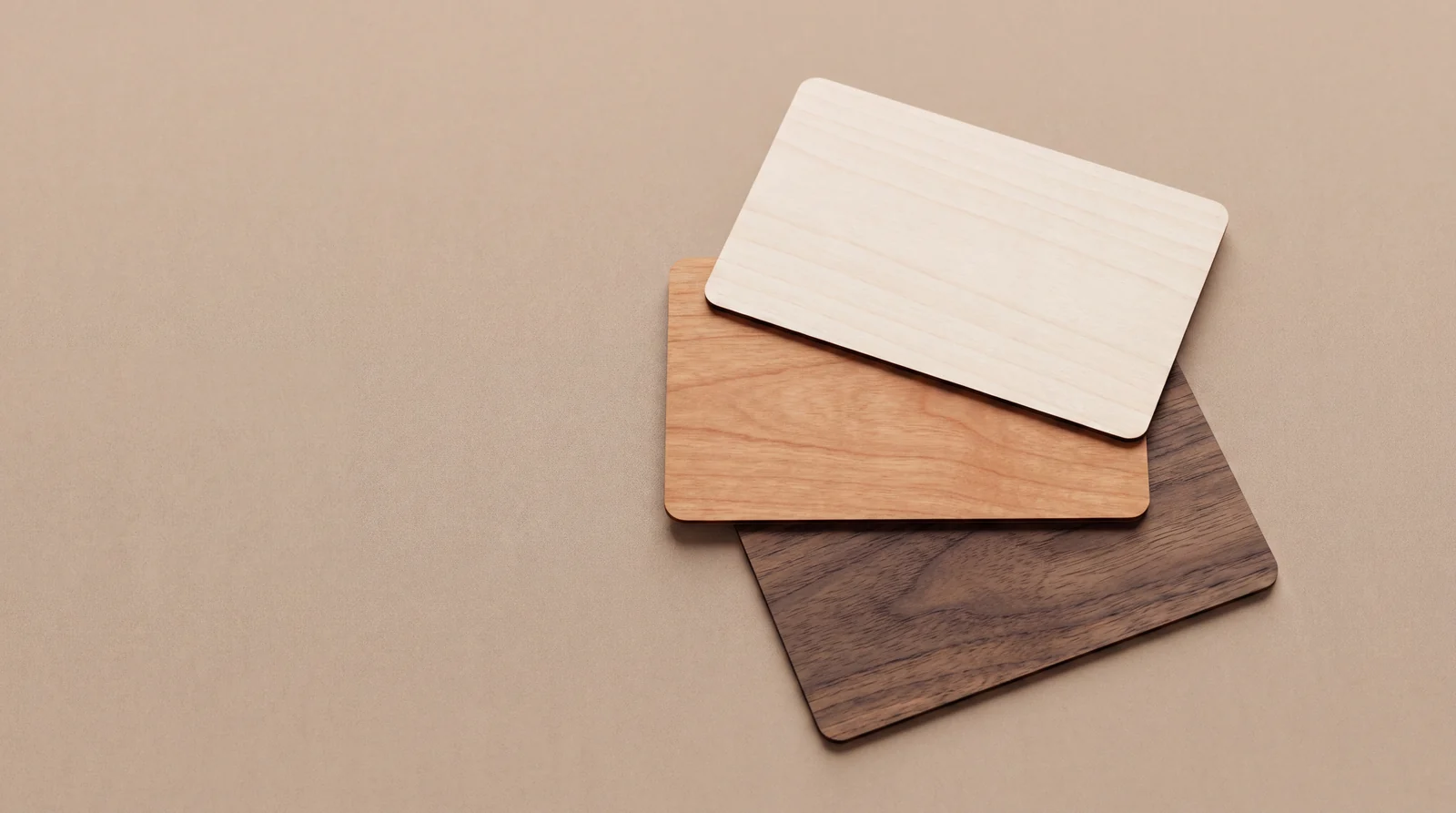
Wooden cards are produced in basswood, cherry, black walnut and bamboo, at 1.20 to 1.30 mm. Grain and tone vary between species and between boards, so no two cards come out identical, and that variation is part of what the material is for.
Colour and grain read differently in a photograph than in the hand. Ask for a physical sample in the species under consideration before the artwork is signed off.
05. What the surface can carry
Full colour print
Offset and silkscreen, Pantone matching, gradients and photography, laminated against wear.
Laser engraving
A permanent, tactile finish burned into the wood. It can be combined with print on the same card, which is the usual choice for a logo that needs to be felt rather than only seen.
UV printing
A gloss highlight on specific areas of the design, used to pick out a mark against the matt grain.
Variable data
Sequential numbering, QR codes, barcodes and chip encoding with a UID list, so the card can carry room information or point at something the property wants the guest to open after check in.
06. It still has to open the door
A card that looks right and does not work is worse than a plastic one that does. The body material has no bearing on which lock system a card opens. That is decided by the chip and its configuration.
Systems our cards are compatible with
Assa Abloy VingCard, including Visionline and Saflok. Dormakaba. Onity. Salto. Häfele Dialock.
Confirm compatibility in writing before production, not after delivery
Send the lock or reader model you already run. We confirm the chip against it in writing before anything goes into production. A general claim that a supplier works with a lock brand is not the same as a confirmation that names your model.
07. What to confirm before you order
1. The lock model, named
Not the brand. The model and the version you actually run, and the encoder the front desk uses. A confirmation that names your model is the only one worth having.
2. What the FSC certificate covers
The number and the scope. Ours is licence FSC-C195226 and it covers wood and bamboo cards. Check it at search.fsc.org.
3. The species, from a physical sample
Grain and tone are the reason for choosing wood, and they are the two things a screen cannot show you.
4. The quantity
Minimum order is 500 units. If you are not sure how that applies to what you need, ask before you specify.
5. The lead time, against your quantity
Lead time depends on the specification and the volume, and it is confirmed in writing against the quantity you are actually ordering rather than published as a single number.
We answer in writing on the working day your request arrives.
Send the reader or lock model, the quantity and the date you need them. That is enough for us to answer.
Talk to us