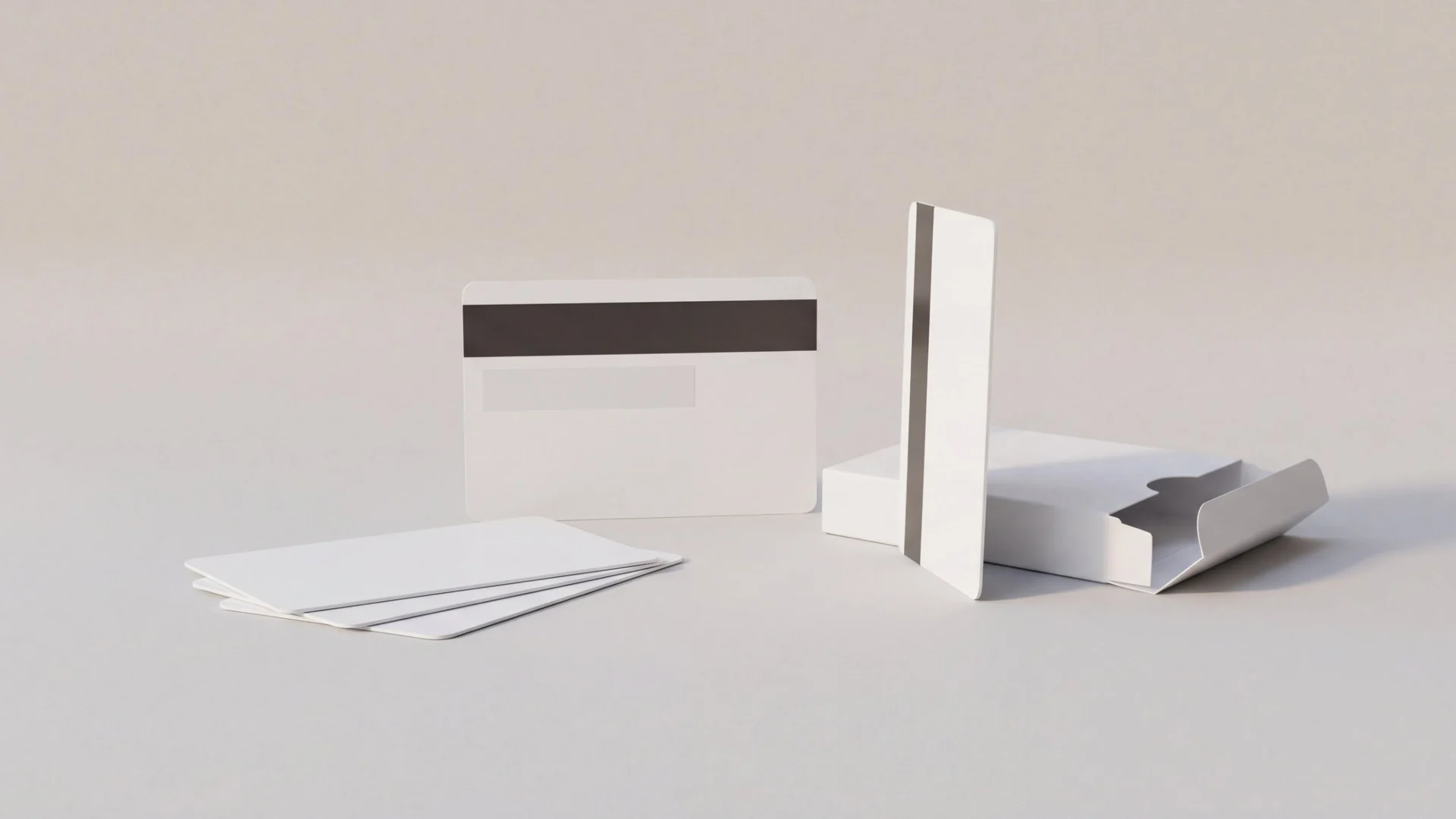
What a gift card specification has to settle before printing: the data carrier, the numbering, the file handover and the read test at the till.
November 10, 2026
/
11
min read
A gift card is two products sold as one. The first is a printed plastic object made in a factory. The second is a value record held in the retailer's platform. Manufacturing produces the first one only, and no step on a production line puts money on a card.
That boundary decides what the physical product has to carry, which is why it belongs at the top of the specification rather than in a clarification email after award. The platform defines the identifier, the format it is read in, and the file that ties a printed card to a record. Written before those three answers exist, a card specification gets re-specified later, usually once a batch is already printed. This guide takes the decisions in the order they actually bind each other: the data layer first, then material and format, then print and finish, then the pilot that proves a card reads at the till. Formats, materials and carriers for the product itself are listed on the gift cards page.
Before printing. Confirm the identifier, its read format and the file that links it to the platform. Then specify the material, finishes and artwork exclusion zones. A test at the till should validate that combination before the production run is authorised.
01. Manufacturing a gift card does not activate value
The balance sits in the retailer's platform. The card carries an identifier the platform resolves to a record, and activation is a transaction that platform performs at the till or through its own interface. A factory can print that identifier, encode it where there is a chip or a stripe, and verify that it reads. It cannot create the record, set a balance or move a card from inactive to active.
Three questions settle the handover. Who generates the numbers: the platform exports a range, or the manufacturer generates one to a rule the platform accepts. Who reserves the range: a block set aside per programme keeps a reorder from colliding with cards already in circulation. How the file travels: a column layout, a character encoding, a transfer method and a named recipient on each side.
Those answers change the drawing, not just the paperwork. A platform that issues its own numbers fixes the digit count and the check digit rule, and that fixes the symbology and the quiet zone the back of the card has to give up. A retailer that runs gift and loyalty on one platform often wants one card for both, which changes the carrier and sometimes the material. The same pattern shows up across retail and loyalty programmes, where the card is the cheapest part of the system and the hardest to change once issued.
02. The data carrier decides most of the card
Four carriers appear on gift card briefs, and the choice is driven by the reader already installed at the point of sale, not by preference. A platform that expects a scanned code will not read a chip, and a till with no scanner cannot use one.
Data carrier comparison
Data carrier
What the card holds
Read path at the till
Specification cost
Printed linear barcode
The identifier as digits, plus a check digit
Any scanner at the lane
Quiet zones, bar height and a matte area in the artwork
Printed QR code
The identifier, or a URL that carries it
Imager or camera scanner only
Module size and contrast; laser scanners cannot read it
Magnetic stripe, HiCo
Encoded track data, written at the plant
Swipe reader
Track layout, coercivity and stripe position
NFC chip, NTAG213, NTAG215 or NTAG216
UID, and a URL with NDEF where the programme uses one
NFC reader or a phone
Inlay position, antenna area and no metallic finish over it
The practical conclusion is that the carrier is chosen by the installed reader and then everything downstream follows from it. A printed code is the cheapest to produce and the most fragile in artwork, because it needs contrast and clear space that a dark full bleed design will not give it. A stripe survives handling well and needs a defined track layout. A chip adds a tap option and takes the metallic finishes off the table over the antenna area. Combined stripe and chip cards are produced in PVC and recycled PVC, and the two carriers have to agree on which one the till reads first. Carrier by carrier detail sits in variable data, numbering, barcodes and QR codes and in the magnetic stripe HiCo and LoCo guide.
03. Numbering is a specification, not a batch instruction
A gift card number is usually a fixed prefix, a serial block and a check digit. Each of the three needs a stated owner and a stated rule, because each one breaks differently. A prefix collision puts two programmes in one number space. A serial block reused on a reorder reactivates cards that were written off. A check digit rule that the platform does not share means a scanner reads a number the platform rejects.
State the digit count, the prefix, the first and last serial of the block, the check digit algorithm and the symbology the number is printed in. Where a programme uses GS1 number structures, state that too, because it constrains the digit count rather than leaving it open. Then state what is verified during production: that no number repeats inside the run, that the printed code reads at a stated grade, and that the encoded track or chip matches the printed digits on the same card.
The data file deserves the same treatment. A column order, a delimiter, an encoding, a row count and a checksum turn a handover into something that can be checked on arrival. Reorders are where numbering discipline is tested, and the practice that keeps a second run identical to the first is set out in reordering and batch consistency.
04. Material and format carry the data layer
Gift cards are overwhelmingly ID-1, the format most quotes call CR80, at 0.76 mm nominal thickness. That format fits wallets, swipe readers and desktop printers, and the acceptance limits around the nominal size are what decide whether a finished card seats properly in a dispenser or a holder. The dimensional side of the brief is covered in CR80 dimensions, fit and tolerances.
Three material routes matter here. Standard PVC is the default and takes every carrier. Recycled PVC, with an eighty per cent recycled core, takes the same carriers and the same print processes, and is specified when a buyer has a recycled content requirement to evidence; the procurement questions it raises are in recycled PVC card procurement. Wood is a premium route with one hard constraint: wooden cards are supplied as contactless RFID or NFC only. A magnetic stripe can be applied to wood, but it wears faster and gives more read problems than on PVC, so it is not recommended. A gift programme that runs on swipe readers is therefore a PVC or recycled PVC programme.
Special shapes and keyring formats are produced, and they are a data decision as much as a design one, because a shape that crops the back of the card can leave a barcode without its quiet zone. Check the carrier against the outline before the die is approved.
Swipe the diagram sideways to see all of it
A gift card is a laminated stack. Each line of the specification lands on one of these layers, and two of them carry the data.
05. Print and finish decide whether the code reads
Finish is usually treated as a brand decision and it is also a read decision. A gloss overlaminate under a lane scanner can throw enough specular reflection to cost reads at an angle. A metallic or foil area over a chip antenna detunes it. A dark background behind a printed code removes the contrast the scanner needs, and a code printed in a brand colour rather than black does the same thing more subtly, because contrast depends on how the scanner's light source sees the ink and not on how the colour looks to a buyer.
The fixes are specification lines rather than compromises. Keep a matte window behind the printed code even on a gloss card. Keep the code in black on white, with the quiet zone stated in millimetres. Keep foil, metallic ink and spot UV off the antenna area and off the stripe. Put the scratch panel where it covers a PIN and nothing else, and state whether the panel area is printed before the panel is applied. Process by process detail is in card printing methods and finishes, and the file side, including bleed and exclusion zones, is in plastic card artwork requirements.
06. Packaging and arrival order are part of the data layer
Cards that carry sequential numbers arrive in a sequence, and that sequence is either useful or a problem to be sorted out by hand at a store. State how cards are collated: in number order within a box, in bundles of a stated count, with a range label on each bundle and on each carton. A store receiving a bundle labelled with its first and last number can confirm what it holds without scanning every card.
State packaging separately from collation. Custom packaging is produced with the client's logo printed in black, one ink. Where a programme needs a hanging carrier or a mailer, confirm which supplier produces it and how the card is attached, because a carrier changes how cards are handled and can hide the printed code until the card is removed. Delivery checks on arrival, including what to verify before a batch is accepted into stock, are set out in the card delivery inspection checklist.
07. The pilot proves the read before the run is released
A gift card programme has one test that matters: a finished card, read by the actual reader at the point of sale, resolved by the platform in test mode. Everything else is an inference. Free samples are available, and a sample in your material and chip goes out before any order, which is what makes a read test possible before production rather than after it.
Run the pilot in a fixed order. Approve the artwork and the exclusion zones. Receive the sample in the specified material, finish and carrier. Scan or swipe or tap it on the installed reader, and have the platform resolve the identifier. Check the printed digits against the encoded data on the same card. Sign off the data file layout with a short test file rather than the full range. Only then release the run. Minimum order is 500 units and standard production is 12 calendar days for PVC and wooden cards, so a pilot that happens after release costs a full lead time to correct.
Swipe the diagram sideways to see all of it
The read test is the gate. Steps 04 and 05 are only worth doing once a finished card has been resolved by the platform it will run on.
08. The Kaway quote checklist
The Kaway quote checklist is the five line specification that lets a gift card run be priced and sampled without a second round of questions.
Information needed for a quotation
Line
What to send
Why it changes the quote
Material and format
PVC, recycled PVC or wood; ID-1 or a shape outline; thickness in mm
Sets tooling, lamination and which carriers are possible
Data carrier
Printed code and symbology, magnetic stripe track layout, or chip reference
Sets encoding, verification and artwork exclusion zones
Numbering
Digit count, prefix, serial range, check digit rule, who owns the range
The recording technique for high coercivity magnetic stripes, which is what a stripe specification has to name instead of simply saying HiCo: iso.org/standard/73639.html.
The GS1 barcode families and the General Specifications behind them, which constrain the digit count and symbology choices described above: gs1.org/standards/barcodes.
10. Where Kaway fits
Kaway manufactures in its own plant in Dongguan, China, and cards have been manufactured at the Dongguan plant since 2007. For gift programmes that means the carriers listed above are produced on one line: printed codes with variable data, magnetic stripe in HiCo or LoCo, and NFC chips including NTAG213, NTAG215 and NTAG216. Encoding is done at the plant, covering UID, sectors and blocks where the chip allows it, and NFC encoding with a URL and NDEF. Every chip is read-tested individually before shipping, 100 per cent rather than sampling.
Three facts tend to decide a gift card schedule. Minimum order is 500 units. Standard production is 12 calendar days for PVC and wooden cards. Free samples are available: a sample in your material and chip goes out before any order, so the read test described in section 07 can happen before a run is committed. Materials, formats and finishes are listed on the gift cards page, and the recycled option is on the PVC and recycled PVC cards page.
Can the factory load a balance onto the cards before they ship?
No. A balance is a record in the retailer's platform, and only that platform can create it or activate it. The factory side is the identifier: printing it, encoding it where there is a stripe or a chip, verifying that it reads, and delivering the data file that lets the platform create matching records.
Do we need a magnetic stripe if the till already scans barcodes?
Usually not. A stripe adds cost and a swipe step for a lane that already resolves a scanned code, and it is worth specifying when the platform expects track data or when the same card has to work on older swipe-only terminals. Where both are needed, combined stripe and chip cards are produced in PVC and recycled PVC, and the specification states which carrier the till reads first.
Can gift cards be produced in wood?
Yes, with one constraint. Wooden cards are supplied as contactless RFID or NFC only. A magnetic stripe can be applied to wood, but it wears faster and gives more read problems than on PVC, so it is not recommended. A printed code on wood needs a tested contrast and a matte area, so the sample matters more than on PVC. Wooden cards are produced at an FSC certified facility (FSC-C195226).
Who should generate the card numbers?
Whoever owns the number space, which is almost always the platform. Where the manufacturer generates the range instead, the specification states the rule, the check digit algorithm and the reserved block, so that a reorder cannot reuse a serial already in circulation.
How long does a gift card order take?
Standard production is 12 calendar days for PVC and wooden cards, and quote requests are answered the same working day. The schedule risk is not production but approval: a read test that happens after release rather than before it adds a full production cycle to the programme.
About this guide
Published by Kaway Group. The date on this page shows when this guide was last updated. If anything here is out of date, or contradicts what your integrator tells you, tell us and we will correct it.
 HospitalityRoom keys, staff credentials and the pieces around them.
 Retail and loyaltyGift, loyalty and membership cards with variable data.
 Access controlCards and fobs matched to the reader you installed.
 Clubs and associationsOne chip for the turnstile, the locker and the desk.
 Events and festivalsWristbands, badges and lanyards for each edition.